Heritage commitee recommended collecting data to address media deserts
By Ahmad Hathout
As the news industry faces an uncertain future, a team of researchers is working to map all news outlets in the country in part to help guide public funds where they are needed most, assist in combating mis- and disinformation, and make reliable news outlets more discoverable.
The government-funded project will utilize advancements in artificial intelligence to help plot Canadian news outlets across the country, which will then go through human verification at the local level, including by library workers in those communities. The result will be a website with an interactive map and searchable directory that will list news outlets in all communities.
“One of the amazing things about this moment in time is we have so many interesting players in our information ecology, but we also have a lot of other stuff, and sometimes the reliable information can get lost,” Christine Crowther, an adjunct professor in the School of Journalism and Communication at Carleton University and the coordinator of the project, said in an interview.
According to a 2025 report from the Canadian Centre for Policy Alternatives, 2.5 million Canadians live in a postal code with only one or no local news outlets. And with concerns emerging that AI-generated summaries are reducing the clickthrough to news sites and Facebook parent company Meta blocking Canadian news on its platforms in opposition to the Online News Act, which forces tech platforms to pay for news links, the project also aims to bring visibility to reliable outlets in an age of misinformation and disinformation.
“So if you are an emerging news outlet or if you’re an established news outlet that’s changing your platforms, it makes it possible for people to find you, for your audiences to find you,” said Crowther, who was a broadcast journalist for 15 years and is also a co-editor and author of the book, Journalism in Crisis: Bridging Theory and Practice for Democratic Media Strategies in Canada.
Last year, the Department of Canadian Heritage separately reached out to three academics with relevant pedigree – April Lindgren of Toronto Metropolitan University (TMU), Colette Brin at Laval University and Magda Konieczna of Concordia University (bios below) – to collect data for the directory after the Standing Committee on Canadian Heritage recommended in late 2024 that the government “collect data to determine the extent of media deserts in order to put in place measures to mitigate them.”
“Pick a place on the map,” Lindgren told the committee in February 2024. “We have no idea what’s going on there in terms of the providers of local news … could we create a searchable directory, first of all for the purposes of policymaking, but also … so that local people can go somewhere and find out sources of local news that they can go to directly?”
The government came knocking and the research team was thereafter formed.
“None of us wanted to do it on our own because it’s a huge undertaking,” Lindgren told us about the initial response. “So we said, ‘well, why don’t we work together and bring our respective skills together to build this thing?’”
Backed with an initial $110,000 from Canadian Heritage, the research team, which hired the non-profit Investigative Journalism Foundation (IJF) to assist in developing the AI tool, was tasked with conducting a literature review and coming up with a methodology before testing in 20 communities of various sizes across the country for the first phase’s proof of concept, which has already been completed.
The second phase will involve testing in all 1,859 communities in Ontario and Quebec before a roll-out nationally in the final phase, after which an AI scrape will be run annually to check for any changes, which will then be reviewed by local verifiers or members of the directory administrators (research team).
Testing and verification will refine the AI tool, which is currently running on a paid version of ChatGPT-maker OpenAI’s API. Crowther said the IJF will be testing the tool’s performance with this API and other large language models (LLMs) to determine which will deliver the greatest accuracy as the project moves forward through its three phases.
Crucially, the database will identify communities with dedicated news outlets and those that get only occasional coverage – defined as outlets typically not based in the community but have enough coverage that residents look to them for news.
“A directory like this will be able to identify places that have no dedicated local news outlets and even no occasional coverage from outlets in nearby communities,” added Lindgren, the founder and co-director of the Local News Research Project at TMU.
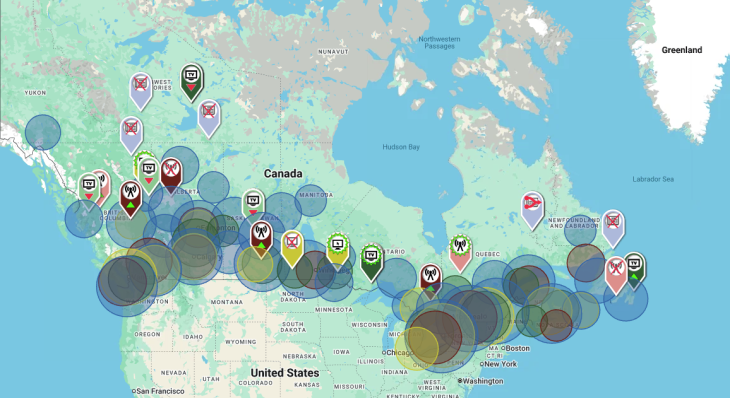
Lindgren is the lead researcher responsible for the Local News Map (LNM), a crowdsourced tool that tracks what news businesses opened and closed, with a refresh every two months. That tool will feed into the new national directory.
According to the LNM’s latest report, between 2008 and August 1, 2026, 430 local news outlets launched across the country but 624 outlets closed.
“Researchers will be able to use the list to dig deeper into what’s going on in the news environment in a community,” Lindgren said about the national directory. “So a place might have five local news outlets, which may sound pretty good, but maybe if you dig into them a little deeper you might find that only one of them is really doing all the heavy lifting in local news coverage and the rest are just producing a story here or there. So it’ll help, I think, set the stage for doing more in-depth analysis of what local news ecosystems look like in different places.”
Once the directory is launched, the public will be able to contact directory administrators about errors and omissions, Lindgren said.
But what took so long for something like this to take shape? Afterall, Lindgren wrote about the concept in a November 2023 article in JSource.
“That’s a huge undertaking because there’s a lot of municipalities in Canada and it would be a big recruitment job to get librarians and convince them to participate and to do the job from scratch … it’s just a bigger ask,” she told Cartt of the thinking at the time.
“But then, with the advent of AI a couple of years ago, it’s becoming more and more capable – with caveats,” she added. “I thought, ‘well, why don’t we build the scraper based on AI and large language models to do a first run at the directory, at the listings, and then we can go to the humans – the local librarians, the other people with local expertise in this topic – and ask them to just look at the list and say, ‘How is it? Is it good? Is it bad? What should be on there? What should be taken off?’
“So that’s a much less onerous job than having to … take responsibility for submitting a list.”
To be clear, there have been attempts at directories before, such as CBC/Radio-Canada’s Local News Directory. A spokesperson told Cartt that the public broadcaster has been in discussions with the research team and “offered them support in a consultative capacity” based on its own experience.
“We understand that the scope of this project is broader,” the spokesperson said, referencing the broadcaster’s own project. “We believe that a strong democracy depends on a diverse media ecosystem — and we support in principle any initiative that contributes to the sustainability and health of the Canadian media sector.”
The problem with the other directories in existence, according to a government memo obtained by Cartt, is that they’re regional and quickly out-of-date.
“We have some directories, but the issue with them is that they’re not always kept updated and they’re also very labor-intensive to create, and so not everybody has the resources to do this on an ongoing basis,” Crowther said.
Lindgren added: “People have tried it before, but the big challenge is they spend a whole bunch of time and money and effort to create a directory and then it becomes … impossibly challenging to keep it up to date.
“The CBC tried getting the news associations to update it whenever something changed in the membership, but that didn’t work very well,” Lindgren added. “Others just haven’t had the time or money to update their data.”
Crowther and Lindgren said the team has been communicating with researchers in the United States, United Kingdom, Australia, France and Belgium to ensure the Canadian team was not duplicating work.
“In the course of our exchanges with them, they gave us some ideas of stuff they’ve tried and they have expressed interest in seeing how this project goes” with the possibility that they may adapt it to their own countries, Lindgren said.
According to the project overview, the team’s research “found that the use of AI tools in other jurisdictions for building lists of local media is typically experimental or used to update existing manually-constructed directories.”
“Nobody else has this combination of verification and AI as the starting point for the data collection,” Crowther added. “So the way that we’re using the AI and the verification together is unique and people are pretty excited by it, honestly.”
The project’s second phase is expected to launch after the team gets its statement of work approved by Canadian Heritage, which confirmed to Cartt that it has received it.
“The Department of Canadian Heritage is currently assessing the second phase of the project, and there is no specific timeline for completion,” a department spokesperson told us. “Each phase is expected to take approximately up to twelve months once a Memorandum of Agreement is in place,” which the spokesperson said will be developed after it has assessed each of the project’s phases.
Canadian Heritage did not answer a question about how much the entire project will cost and whether it expects and is prepared to foot the bill for it and its maintenance, which is expected to be of minimal cost.
Crowther, who said the team is open to working with other funding partners, added they will embark on building partnerships with news organizations, libraries, schools and municipalities to host links to the website and, in the case of libraries and schools, develop resources to encourage members of their communities to use the directory.
The development of the database comes as private broadcasters shed news jobs and as the federal government and the CRTC consider how to better support the industry.
The regulator has already ordered streamers to put money into the Independent Local News Fund (ILNF) to support news, a policy that is being challenged in court and which may now be in jeopardy following the government’s public opposition to financial obligations on streamers. In lieu of that, Culture Minister Marc Miller recently announced an injection of $600 million to support Canadian content, some of which Corus wants directed to news content. The federal government is, in the meantime, considering extending news tax credits to broadcast news.
More information about research leads, via the project overview
Prof. April Lindgren is professor emerita and adjunct professor at the Toronto Metropolitan University School of Journalism. She founded the Local News Research Project (LNRP) in 2008 and currently co-directs the initiative. Her research focuses on local news poverty, a term she uses to describe situations where the critical information needs of communities are not being addressed by local media. She spearheaded creation of the crowd-sourced Local News Map, an ongoing project that tracks the launch – and loss – of local news organizations in Canada, and has led research projects documenting the extent to which local news is at risk and unevenly available across the country. She launched and led (2021-2025) the Local News Data Hub, a student-industry collaborative project committed to shoring up local journalism by supplying newsrooms with data-based local stories and training student data journalists. Ongoing LNRP projects include data gathering for the Local News Map and an investigation of how philanthropy can support local journalism. Prof. Lindgren was the Velma Rogers Research Chair from 2018 to 2021 and founding director of the Ryerson Journalism Research Centre from 2011 to 2018.
Prof. Colette Brin is the director of the Centre d’études sur les médias, a research nonprofit associated with Université Laval. She is co-lead of the Arts, Media and Cultural Diversity Axis of OBVIA, an interuniversity network on responsible AI comprising over 240 research members as well as numerous partners in Quebec and internationally. From 2020 until August 2025, she chaired the Advisory Board on Eligibility for Journalism Tax Measures, working closely with the Canada Revenue Agency to design and apply the assessment process for designation as Qualified Canadian Journalism Organization (QCJO). Over her academic career spanning more than 25 years, she has managed numerous research projects, including several funded by Department of Canadian Heritage programs (Digital News Report Canada, 2018- 2023 and 2024-2025; Development and testing of an online educational tool to counter online disinformation among young adults, 2019-2021). She has authored and supervised studies of local news provision in Quebec leading to construction of news sources datasets. Prof. Brin was a visiting scholar at the Reuters Institute for the Study of Journalism, University of Oxford, for the 2025 – 2026 academic year.
Dr. Magda Konieczna is an associate professor of journalism at Concordia University in Montreal. Her work focuses on the connections between journalism and democracy through examinations of new business models for news, the growth of collaborative news production, and a community-centered approach to journalism. She is the author of Journalism Without Profit: Making News When the Market Fails (Oxford University Press, 2018) and was a city hall reporter at the now-closed Guelph Mercury. She is the founder and co-director of Documenters Canada, funded through a Partnership Development Grant and a Partnership Engage Grant from the Social Sciences and Humanities Research Council (SSHRC) and an Inspirit Foundation grant. This project trains and pays community members to document public meetings in their communities, building on the Documenters program in the United States, which began in Chicago in 2016.
Screenshot from the Local News Map