
As demand for data, cloud services and high-capacity connectivity grows, the infrastructure supporting Canada’s digital economy is becoming more important than ever.
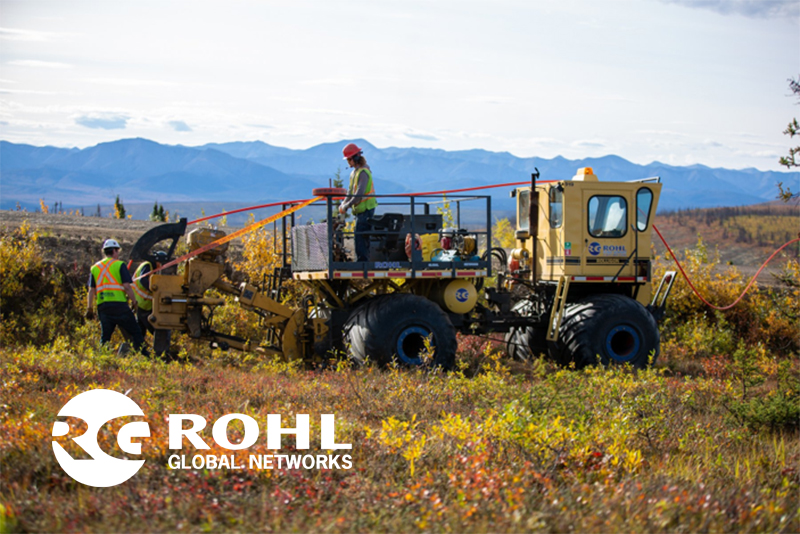
Image: Cable plough on the Dempster corridor, Yukon — ROHL crews placing fibre across open tundra.
Canada’s digital future depends on infrastructure that most people will never see.
Beneath highways, across remote landscapes and between major network hubs, fibre optic networks carry the data that keeps businesses, communities and essential services connected. As demand for bandwidth increases, the challenge is no longer simply extending connectivity. It is building the capacity, resilience and flexibility needed to support what comes next.
From expanding data centre requirements to cloud computing, artificial intelligence and growing enterprise networks, Canada’s telecommunications infrastructure is entering a new phase of development.
And behind that transformation is an increasingly important combination of high-capacity fibre networks, experienced infrastructure builders and long-term network planning.
Building Capacity for a More Connected Canada
The importance of reliable telecommunications infrastructure continues to be reflected in national connectivity initiatives.
The Canadian Radio-television and Telecommunications Commission (CRTC) has committed hundreds of millions of dollars through its Broadband Fund to improve connectivity in underserved communities, including support for thousands of kilometres of fibre transport infrastructure.
Yet Canada’s connectivity requirements extend beyond bringing broadband to individual households.
Carriers, internet service providers, data centre operators and large enterprises increasingly require scalable network infrastructure capable of transporting significant volumes of data between locations.
This is where dark fibre, dedicated wavelength services and high-capacity optical connectivity play an important role.
Dark fibre allows network operators to access fibre optic infrastructure and deploy their own optical equipment, giving them greater control over network capacity and future upgrades. Wavelength services provide another option for organizations requiring dedicated, high-bandwidth connectivity without operating the underlying fibre infrastructure themselves.
As network requirements evolve, access to both solutions can provide greater flexibility in how organizations design, expand and manage their connectivity.
The Infrastructure Behind the Network
Building a fibre network involves considerably more than installing cable.
Every route requires careful planning, engineering, permitting and coordination. Geography, environmental conditions, existing utilities and accessibility can all influence how infrastructure is designed and constructed.
In Canada’s northern and remote regions, these challenges can become even more complex.
Difficult terrain, limited construction seasons and significant distances between communities demand specialized equipment, experienced crews and an understanding of how to deliver projects in challenging environments.
ROHL Global Networks brings more than five decades of telecommunications infrastructure experience to this work, with capabilities spanning fibre network planning, route selection, design, permitting, construction, splicing, testing and maintenance.
Through ROHL Gateway Fiber, the organization also owns and operates fibre infrastructure, providing dark fibre, wavelength and connectivity solutions for carriers, service providers, data centres and enterprises.
Together, these capabilities connect two important parts of the telecommunications industry: building the infrastructure and enabling organizations to use it.
A Network Built for Capacity and Redundancy
ROHL Gateway Fiber owns and operates long-haul fibre through northern Alberta and northeastern British Columbia, anchored by two backbone routes: Edmonton to Fort St. John, and Valleyview to High Level.
Points of presence across the network are built to carry traffic through extended utility outages, with 72 hours of on-site backup power at each PoP site. The network supports 400G per circuit, giving carriers, hyperscalers and data centre operators room to scale without waiting on a new build.
Further routes are under construction now, scheduled for completion in 2027, extending reach toward the industrial and power-generation corridors where Canada’s next generation of data centres is being planned.
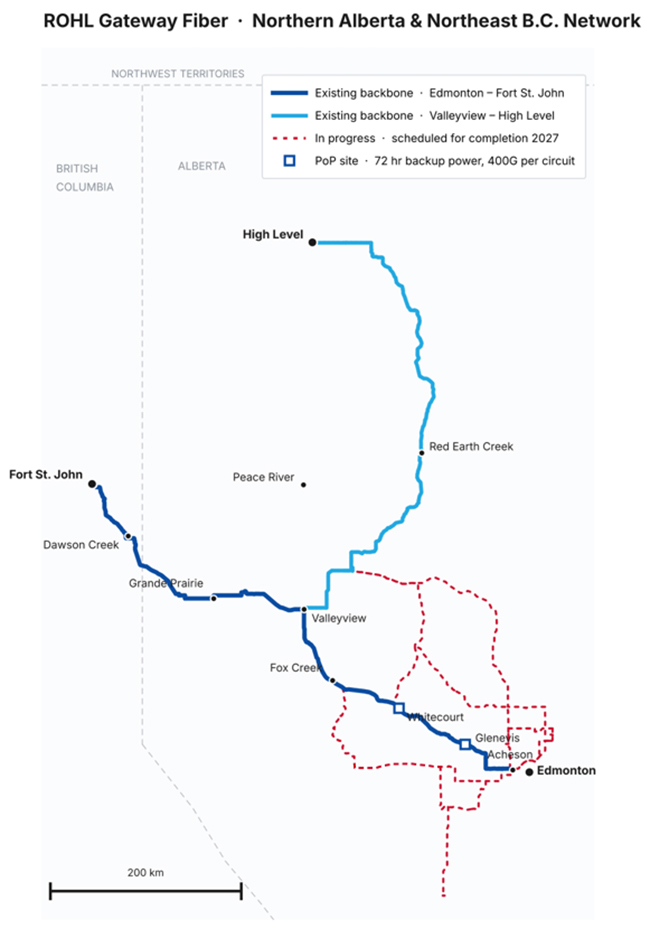
Image: ROHL Gateway Fiber network — existing backbone, corridors in progress, and PoP locations.
Project in Focus: The Dempster Fibre Line
ROHL’s experience delivering complex telecommunications infrastructure is perhaps best illustrated by the Dempster Fibre Line.
In 2021 the Government of Yukon awarded ROHL the contract to design, permit and construct 778 kilometres of fibre along the Dempster Highway, from Dawson City, Yukon to Inuvik, Northwest Territories. ROHL delivered the project in collaboration with several local First Nations governments and businesses, working alongside Indigenous communities whose traditional territories extend throughout the route of the new network.
The route crosses some of the most difficult terrain in North America — from the mountains beyond Dawson City to continuous permafrost and major river crossings, including a 1.3-kilometre directional bore beneath the Mackenzie River, with the network extending north to the Arctic Ocean at Tuktoyaktuk. Roughly 89 per cent of the line was plowed in underground using low-ground-pressure equipment, with handholes built above grade so the permafrost was left undisturbed. Crews worked through snowstorms, wildfires, flooding and road washouts across three construction seasons.
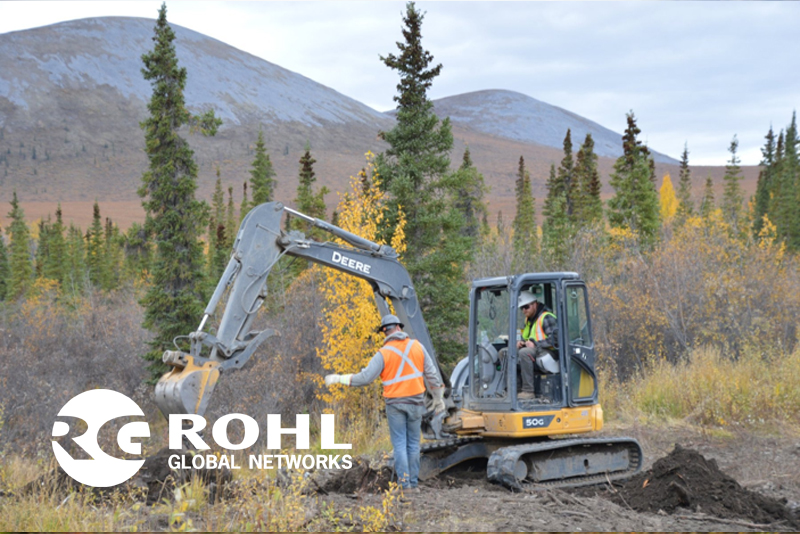
Image: Clearing and trenching through mountain terrain north of Dawson City.
Construction finished ahead of schedule in September 2024, and the line entered service that November. It closed the Canada North Fibre Loop, a 3,857-kilometre redundant ring. Until then, Canada’s North depended on a single fibre route.
The corridor crosses the traditional territories of eight First Nations and Indigenous groups, and ROHL built the project in partnership with Indigenous communities, businesses and development corporations the whole way along. Indigenous participation was built into the contract from the outset, with measurable results: ROHL’s Indigenous Participation Strategy delivered measurable economic and employment benefits throughout the project, with 20% of the total contract value awarded to Indigenous businesses and more than 32,471 direct employment hours provided to First Nations citizens.
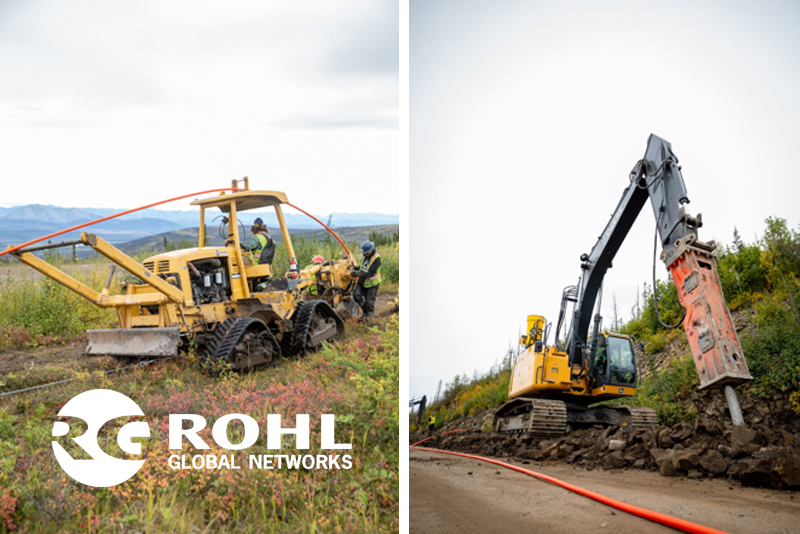
Image: Left: ploughing duct into the tundra. Right: breaking rock on the Dempster right-of-way.
The Yukon Government recognized the effectiveness of this approach, with elements of ROHL’s Indigenous Participation Strategy subsequently incorporated into its procurement standards for future infrastructure projects of a similar nature.
Few fibre infrastructure projects in North America have presented the scale and complexity of the Dempster Fibre Line.
Preparing for the Next Generation of Connectivity
As network traffic increases, telecommunications providers are looking beyond today’s bandwidth requirements.
High-capacity optical technologies are central to that planning, but supporting the next generation of connectivity requires more than bandwidth alone. But technology alone does not create a resilient network.
The underlying fibre routes, network access points, maintenance capabilities and opportunities for future expansion are equally important considerations.
For carriers and enterprises evaluating long-term connectivity, questions about network diversity, route availability, scalability and infrastructure ownership can be just as significant as the bandwidth available today.
ROHL Gateway Fiber’s focus on dark fibre and high-capacity connectivity reflects this broader shift toward infrastructure designed to support evolving network requirements.
A View from ROHL
“For decades, ROHL has played a significant role in building Canada’s telecommunications infrastructure. We own and operate critical fibre networks connecting northern Alberta and northeastern British Columbia, and have been responsible for the majority of telecommunications fibre network construction throughout Yukon and the Northwest Territories. Our portfolio includes the Dempster Fibre Line, the Tuktoyaktuk extension, some of the most technically and logistically challenging fibre builds along the Alaska Highway, and significant involvement in the construction of the Alberta SuperNet.
We’ve also partnered with service providers such as Arrow Technology Group to bring high-speed fibre connectivity to more than 20 First Nations communities, delivering the same standard of service available in major urban centres. We’re proud of that history, the partnerships we’ve built, and the lasting impact of that work.
Today, Canada faces a new infrastructure challenge. The rapid expansion of artificial intelligence is driving unprecedented demand for power, computing capacity, and high-performance connectivity. Canada has an abundance of the energy and natural resources needed to become a global leader in AI infrastructure, but we still lack the fibre capacity, route diversity, and network resilience required to fully realize that opportunity.
This is the next chapter for ROHL. We’ve spent decades building critical networks across some of Canada’s most challenging environments, and we’re ready to apply that same experience and determination to developing the next generation of long-haul dark fibre infrastructure. Our ambition is to help establish the connectivity backbone that will support Canada’s AI economy for decades to come.”
— Hans Bongers, Chief Executive Officer, ROHL Global Networks
Connecting What’s Next
Canada’s next generation of digital infrastructure will depend on more than faster connections. It will require greater network capacity, improved resilience and the ability to support increasingly data-intensive industries.
From constructing complex fibre routes in Canada’s most challenging environments to owning and operating high-capacity networks, ROHL Global Networks and ROHL Gateway Fiber are helping build the infrastructure needed for what comes next.
Because behind every digital advancement is something fundamental: the network that makes it possible.
About ROHL Global Networks and ROHL Gateway Fiber
ROHL Global Networks has more than five decades of experience delivering telecommunications infrastructure projects across North America, including fibre network design, construction, installation, testing and maintenance.
ROHL Gateway Fiber owns and operates fibre infrastructure serving North America, offering dark fibre, wavelength and connectivity solutions for carriers, service providers, data centres, enterprises and other organizations requiring high-capacity network access.
Learn more at rohlgatewayfiber.com.
HIGH QUALITY JOURNALISM REQUIRES AN INVESTMENT.
Cartt.ca publishes breaking news, in-depth feature stories, analysis, and opinion geared specifically for those working in the cable, radio, television, and telecom industries in Canada.
Breaking news, top-notch analysis and commentary is posted as it happens while twice-weekly newsletters compile those stories and deliver them directly to more than 4,000 industry subscribers. Cartt.ca offers credible journalism for the industry professional.