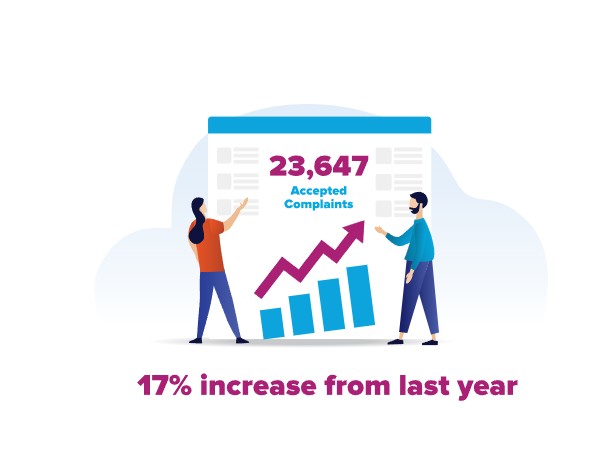
The Commission for Complaints for Telecom-television Services (CCTS) received a record number of complaints from telecom and TV customers this past fiscal year, with billing problems continuing to be the leading complaint issue, according to the CCTS’s annual report published early Wednesday.
Between Aug. 1, 2024 and July 31, 2025, the CCTS accepted 23,647 complaints from customers across Canada. This represents a 17 per cent increase from the previous year and is the highest number of complaints accepted in the CCTS’s history.
The top 10 issues raised across all service types were: incorrect charge for monthly price plan; disclosure issues; credit or refund not received; quality of service; regular price increase of monthly price plans; breach of contract; changes to the contract; complete loss of service; third-party credit reporting; and termination fees.
Except for disclosure issues, which decreased in volume by 16 per cent year-over-year, all of the other top 10 issues increased year-over-year. Notable increases occurred with contract-related issues, such as breach of contract (up 121 per cent) and changes to the contract (up 34 per cent). Issues related to billing and credit also continued to grow, including: regular price increase of monthly price plans (up 61 per cent), termination fees (up 33 per cent), and third-party credit reporting (up 27 per cent).
In general, billing-related issues remain a top concern for telecom and TV customers, increasing in volume by 16 per cent year-over-year and reaching the highest number of billing issues reported in the last five years. Overall, billing problems accounted for 46 per cent for all issues raised in complaints.
One other notable trend is issues related to TV services increased by 44 per cent this year. However, TV services accounted for only 14 per cent of all issues raised in complaints, whereas wireless services accounted for 51 per cent and internet services accounted for 27 per cent of all issues raised.
Rogers (including Shaw) is the service provider with the highest proportion of complaints accepted by the CCTS (27 per cent), followed by Telus (21 per cent) and Bell (17 per cent).
Out of the top three most-complained-about providers, Telus had the largest year-over-year increase in accepted complaints (up 78 per cent). Rogers/Shaw and Bell saw complaint increases on par with the 17 per cent increase in complaints across all providers.
Noting its relatively lower CCTS complaint rate and higher resolution rate in previous years, Telus said in a statement that, “We acknowledge our complaint volumes increased this past year, and take full responsibility for these results, seizing every interaction as an opportunity to improve, because our customers’ feedback drives meaningful change across our organization. Extensive efforts are underway to address key customer concerns, including introducing a new five-year price lock to our 5G+ Complete mobility plans to protect customers from surprise rate increases, continued network improvements across Canada reducing dropped calls, and using AI to help frontline agents resolve customer complaints the first time they call. We thank our customers for their feedback, continued trust and industry-leading loyalty, and remain committed to delivering exceptional customer experiences as we evolve to better serve their needs.”
The CCTS said in the report that it had expanded its public awareness activities, including adding podcast advertising this year, and as a result reached more consumers across Canada through media relations, radio, digital campaigns, and social media. It said it saw a “13% year-over-year increase in CCTS website traffic. Customer survey data showed a significant increase in the proportion of customers who discovered the CCTS via social media.”
Bell pointed to this as a possible explanation for the increase in complaints.
In a statement to Cartt on Wednesday, Rogers said it made more than 120 process improvements in 2025 based on customer feedback and it continued to invest and improve its tools to support the customer experience. Rogers said it launched digital tools and technology to make it easier for customers to get answers, including Rogers Support Search, Resolve Your Concern, and Billing Inquiry, and enhanced internal tools with AI to support the customer experience.
“We’re working hard to ensure we deliver a great experience for our customers at every touchpoint,” Rogers said in its statement. “As Canada’s largest wireless and national cable company, we have millions of customer interactions every month and while only a small percentage result in a complaint, we know there’s more work to do.”
Some providers pointed to their progress in reducing customer complaints. Cogeco, Videotron and Freedom, for example, had lower billing and disclosure issues on a year-over-year basis.
“Cogeco is pleased with these results and proud of our team for achieving a 15% reduction in complaints and zero Internet Code breaches, a success driven by our organization-wide commitment to a superior customer experience,” Cogeco said in a statement to Cartt.
Videotron said in a press release Wednesday: “While complaints about Canadian telecom providers rose by 17% overall, the Videotron Group, which includes the Videotron, Freedom Mobile, Fizz and VMedia brands, once again delivered superior customer satisfaction, according to the 2025 Annual Report of the Commission for Complaints for Telecom-television Services (CCTS) released today.”
In its first appearance in the CCTS annual report as a nationwide service provider, the Videotron group “was in a class of its own with stable numbers despite significant subscriber base growth, while the other major national carriers experienced significant complaint increases,” Videotron said in its press release. “The Videotron brand maintained its leadership with its fourth consecutive annual decline in complaints (-6.6%).”
It should be noted the 6.6 per cent decrease in customer complaints was achieved by the Videotron brand alone. The individual Freedom Mobile, Fizz and VMedia brands saw complaints increase year-over-year by 6.2 per cent, 32.8 per cent and 87.9 per cent, respectively.
The Canadian Telecommunications Association, a trade group with members including Rogers, Bell and Videotron, said in a statement: “Telecommunications service providers take customer concerns seriously and work continuously to improve the customer experience. The CCTS report should be viewed in the broader context of the scale and reach of Canada’s communications networks. Relative to the tens of millions of Canadians who use telecom services every day, the number of complaints accepted by the CCTS represents less than 0.1% of subscribers nationwide.
“Importantly, an ‘accepted complaint’ is not a finding that a service provider has done something wrong; it simply reflects that an issue raised by a subscriber falls within the CCTS’s mandate,” the statement continued. “In fact, the vast majority of complaints—nearly nine in 10—are resolved without the CCTS having to investigate or determine the merits of the issue. Our members remain focused on resolving issues quickly and effectively, and continuing to invest in improving reliability, service quality, and customer care for Canadians.”