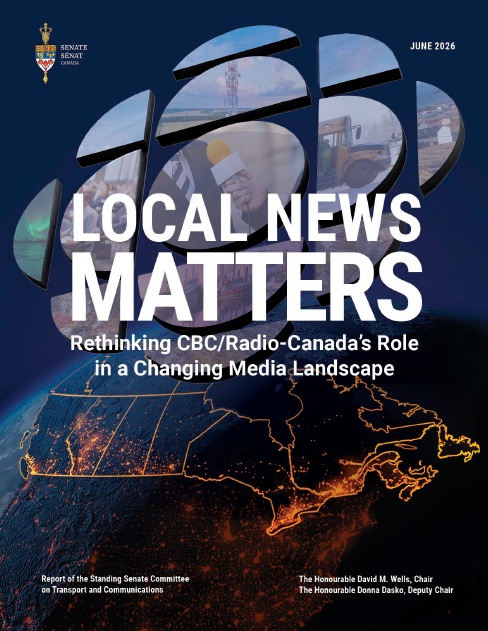
CBC/Radio-Canada has an opportunity to better serve small communities lacking media coverage and should have “the reflection of local communities and audiences” explicitly stated in its mandate, according to a report by the Standing Senate Committee on Transport and Communications released Wednesday.
Having the national public broadcaster’s mandate officially amended in the Broadcasting Act was one of seven recommendations made by the senate committee in its report, which is the culmination of a study undertaken by the committee in 2024 and 2025 to examine the local services provided by CBC/Radio-Canada. More than 60 witnesses appeared at the committee’s public hearings.
In its report, the committee recommends that “the Government of Canada provide stable, multi-year funding to CBC/Radio-Canada to enhance local programming and that CBC/Radio-Canada continue to invest to enhance and prioritize local programming.”
Noting that financial data of CBC/Radio-Canada’s local services are not publicly disclosed currently, the committee recommends that the CRTC impose new reporting requirements on local services provided by the public broadcaster on both its traditional and its digital platforms. These requirements should be introduced at CBC/Radio-Canada’s next licence renewal in 2027, the committee says, adding the reports should be public and provide data on local programming and expenditures for these services.
The committee also recommends Canada’s national public broadcaster should implement new initiatives to collaborate at the local level with private and community media outlets in all regions of the country.
The committee’s report notes public trust in the media, and specifically in CBC/Radio-Canada, has been declining for years. In light of this, the committee recommends CBC/Radio-Canada periodically conduct analysis by outside experts to assess the fairness and balance of news and current affairs content provided by CBC/Radio-Canada news services.
During its public hearings, the committee heard from organizations representing official language minority communities (OLMC) who spoke about “the essential role that CBC/Radio-Canada’s regional and local stations play in the vitality of the communities they represent,” according to its report. The committee recommends that CBC/Radio-Canada ensure its investments in television production for OLMC “clearly and equitably respect the principle of substantive equality.”
The committee’s final recommendation is that CBC/Radio-Canada should examine the role it can play in emergency situations: “In remote and isolated areas with limited alternative broadcasters, that CBC/Radio-Canada be capable of providing full coverage in the event of an emergency.”
“With trust in CBC/Radio-Canada dwindling, it’s clear that the broadcaster’s mandate needs to better reflect the different realities of Canada’s small towns and local communities. Robust oversight of CBC’s news and current affairs will help ensure fair and balanced coverage across the country,” Senator David Wells, chair of the committee, said in a Wednesday news release.
“The CBC plays an important role in shaping Canada’s identity, but many Canadians don’t see their communities in the national broadcaster’s coverage,” Senator Donna Dasko, deputy chair of the committee, said in the news release. “This report provides recommendations to help the CBC bring more programming to more communities and better capture who we are as a country.”
A CBC/Radio-Canada spokesperson told Cartt that the broadcaster is still studying the report and does not have a comment at this time.
Cover page of the Local News Matters: Rethinking CBC/Radio-Canada’s Role in a Changing Media Landscape report from the Standing Senate Committee on Transport and Communications