By Ahmad Hathout
Officials from the federal government had tried and failed for months to get a formal response from the government of Nunavut on a revised scope for the West Hudson Fibre Link project, according to briefing material obtained by Cartt.
In December 2022, Innovation, Science and Economic Development (ISED) conditionally approved an undisclosed amount of money – in the millions of dollars – from the Universal Broadband Fund (UBF) to connect 1,851 underserved households in Arviat, Rankin Inlet, and Coral Harbor via undersea fibre cable and bring redundancy by connecting from Churchill, Manitoba to the satellite-dependent territory.
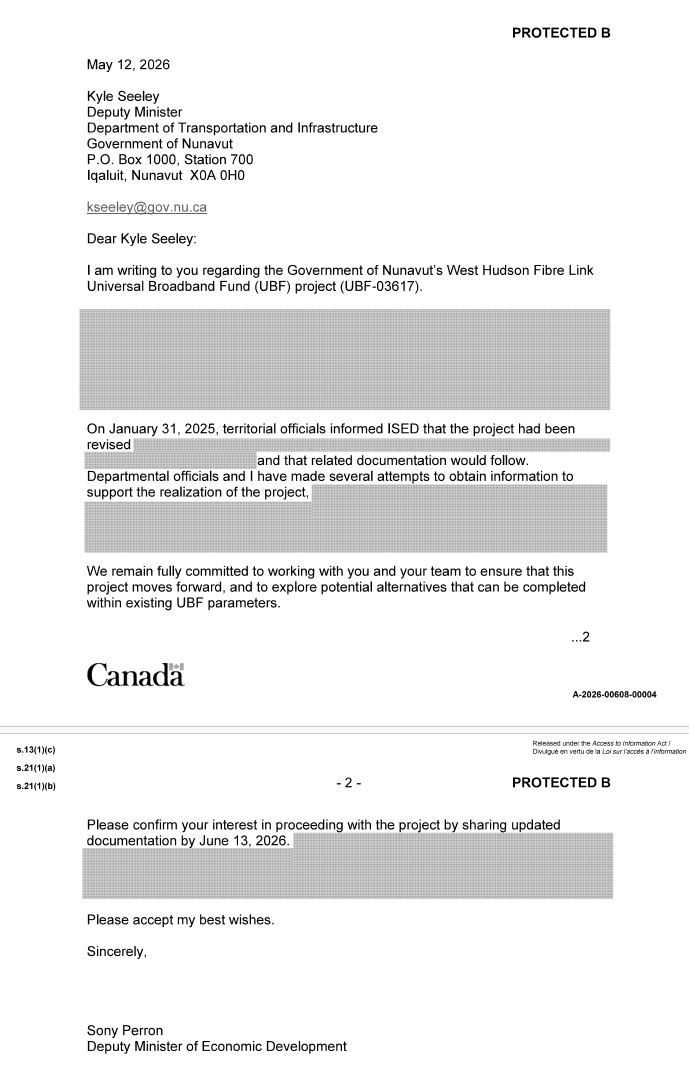
On January 31, 2025, the territorial government submitted a revised project scope, according to an undated briefing summary. Since then – and despite follow-up meetings – ISED officials had not received a formal response, such as updated documentation “to support the realization of the project,” according to the summary and letters from ISED urging action.
“ISED has continued to make several attempts to work with the GN to obtain the necessary information for the re-scoped project,” according to the summary document, which adds that counterpart officials met on May 28, 2025 to discuss a related matter that is redacted in the document.
“When no submission was provided, ISED followed up on November 14, 2025,” the summary continues. “On February 11, 2026, ISED met with GN officials where they indicated that they would be submitting proposal options by the end of March 2026.
“No submissions have been received to date,” the summary adds.
The next month, on April 13, 2026, ISED officials again reached out to Nunavut counterparts in the Department of Transportation and Infrastructure (DTI) “offering to meet again to discuss advancing the GN’s broadband project,” the summary notes. “The GN has not yet responded to your most recent meeting request.”
Earlier that month, the federal government announced more than $86 million for a Northwestel satellite project to bring high-speed internet to 11,650 households, reaching all 25 communities in the territory. It’s part of the government’s drive to provide high-speed internet access – with speeds of at least 50 Mbps download and 10 Mbps upload – to all households by 2030.
ISED officials leveraged that announcement in its communications with DTI to convey the federal government’s commitment to bringing connectivity to the region.
In a May 12, 2026 letter to Kyle Seeley, DTI’s deputy minister at the time, ISED Deputy Minister of Economic Development Sony Perron noted that his department has made “several attempts” to get the relevant documentation and that “we remain fully committed to working with you and your team to ensure that this project moves forward.”
Perron even offered to explore “potential alternatives that can be completed within existing UBF parameters” to see the project through.
“In light of other projects underway, please confirm your interest in proceeding with the Government of Nunavut’s project by sharing updated documentation by June 12, 2026,” one letter from ISED reads. On June 19, Seeley was shuffled out of the position.
Cartt put several questions to both sides, including the last time there has been a communication on this matter; what a rescope will look like; how much it will cost; if this project is still moving forward; and what a delay means for the government’s connectivity goals.
“ISED continues to work with the Government of Nunavut as it reassesses the scope of its fibre projects in light of changing project costs and considers how these projects can best complement other connectivity investments underway in the territory,” a department spokesperson told us. “The Government of Canada remains prepared to work with Nunavut as this assessment moves forward.
“As the proponent for this particular project, the Government of Nunavut’s Department of Transportation and Infrastructure is responsible for project delivery and is best placed to provide details regarding its proposed revised scope, updated project costs, and construction timeline,” the spokesperson added.
“The government’s Connectivity Strategy commits to connecting all Canadians to high-speed Internet by 2030, with an interim goal of national coverage at 98% by the end of 2026,” he continued. “The Government of Canada is making strong progress and is on track to reach its goals, but there is still work to do. Connecting the North requires a flexible approach, as well as different technologies and solutions.”
A DTI spokesperson told Cartt the following in response to several questions, including why the department hasn’t responded to ISED: “Transportation and Infrastructure Nunavut’s officials are committed to maximizing public infrastructure investment to deliver the highest possible value to the territory. The West Hudson Fibre Link proposal discussions are currently centered around how we can maximize the value of northern fibre connectivity for all Nunavummiut. We continue to work closely with ISED on our shared objective to bring fibre to Nunavut.”
This is a transformational period for the territory, which is embarking on massive infrastructure projects to connect its remote communities and cease relying so much on satellites.
In July 2024, the CRTC approved Nunavut’s $272-million funding application for the Kivalliq Baffin Connector, a transport project that will bury more than 1,000 kilometres of undersea fibre cable to connect the communities of Iqaluit, Kinngait, Kimmirut, and Coral Harbour, which represent over a quarter of the territory’s population. In February last year, the CRTC approved the government’s statement of work for the project.
The Kivalliq Hydro-Fibre Link proposes a 1,200-kilometre, 150-megawatt transmission and fibre line from northern Manitoba to the Kivalliq region, which Nukik Corp., the entity that proposed the project, said would “connect Nunavut to Canada’s electricity and telecommunications backbone for the first time.”