By Ahmad Hathout
The department of Innovation, Science and Economic Development (ISED) is temporarily authorizing SpaceX’s use of the E-band after receiving broad support.
The American aerospace company filed a request with ISED in December requesting that its Starlink broadband satellite service be able to utilize the E-band (71-76 GHz downlink and 81-86 GHz uplink) for fixed satellite service (FSS) communications between its satellites and gateway earth station located at Saint-Laurent, Quebec and Janet, Alberta, which are currently serving users via the Ka-band. The E-band is used by terrestrial wireless network providers for backhaul, and SpaceX wants to use it to expand connectivity in rural and remote communities.
“ISED is of the view that temporarily permitting SpaceX’s requested use of E-band frequencies at the two sites on a NINP [no interference, no protection] basis is in the best interest of Canadians; particularly those in underserved and unserved areas where connectivity may be limited due to cost or infeasibility of building out additional terrestrial infrastructure,” the department said in its decision last week.
“Given the propagation characteristics of E-band and the highly directive antenna radiation envelope for the FS deployments in these bands, ISED is of the view that the risk of harmful interference is low,” ISED said, adding the decision is subject to coordination with existing fixed service stations.
Among those that supported the proposal was Rogers, which backed it on an interim basis, so long as there’s no interference with current use, which for Rogers and other wireless network operators is to scale 5G transport and other point-to-point backhaul systems.
“[Future fixed service, FS] and FSS have typically coexisted effectively, owing to the technical characteristics of their deployments, so any additional use (by FSS) can be introduced in such a way to preserve terrestrial backhaul growth and investment certainty for the benefit of Canadian mobile users,” Rogers said. “Permitting SpaceX with FSS E-band authorization ahead of [World Radio Conference 2027] and domestic consultations will also benefit Canadian users and the broader economy by supporting additional investment in Canadian telecommunication facilities.”
Rogers has partnered with SpaceX to launch its satellite-to-mobile product.
Rural broadband service provider Xplore asked the department to deny the request until international standards are established by the International Telecommunications Union for co-existence with ground mobile wireless networks.
But ISED said, “with the limitation to two earth station sites,” it “believes that FS operations in E-band will be sufficiently protected and that the concerns expressed by those who opposed authorization prior to WRC-27 will be mitigated.”
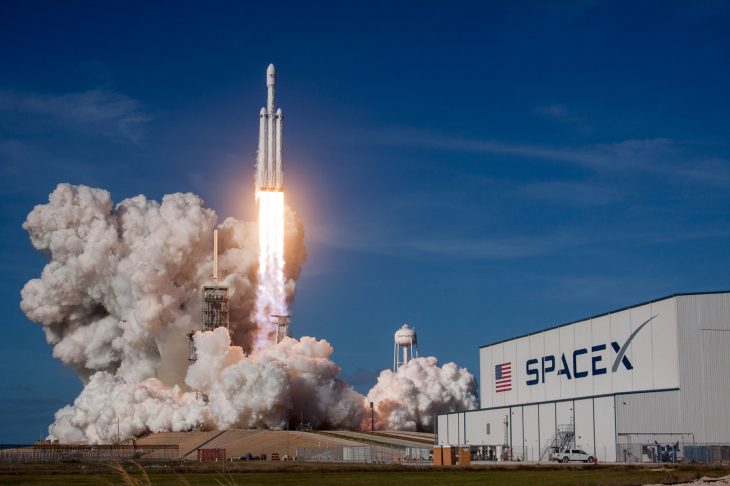
Photo via SpaceX