By Ahmad Hathout
The CRTC on Monday ordered online streamers to provide closed captioning (CC) for their entire program catalogues by 2031.
Within that space of time, the streamers will have one year from now to provide CC for all new original pre-recorded English- and French-language programs; all original English- and French-language live programs, including those made by a third-party supplier; and all previously captioned programs on traditional TV.
To strike a balance between accessibility and avoiding straining CC resources, the CRTC said it will give them four years to have CC on 80 per cent of their program catalogues and five years for the rest. It is “encouraging” the streamers to make the most frequently streamed/most popular programs available with CC first “in order to benefit the widest possible audience as soon as possible” and to report progress annually.
“This time will help ensure that closed captioning is accurate and of high quality,” said the regulator, which launched the consultation on this matter in June 2024 as part of the implementation of the Online Streaming Act.
Streamers will also need to provide CC for all promotional and short-form programs that they create and that they get from third parties.
The CRTC will require 100 per cent accuracy on captioning for new original pre-recorded programs, which includes accurate spelling, non-speech contextual information (e.g. sounds in the background), and the identity of speakers and their manner of speaking, “to the fullest extent possible.”
The captions must also be placed where it won’t interfere with visual elements and, to the greatest extent possible, must be in sync with spoken words and must ran from beginning of the program to the end.
The CRTC will not require specific accuracy rates for original live programs or for third party programs, but will revisit the issue in a future proceeding as automated or AI CC technologies “become more sophisticated.”
The regulator is also expecting online streamers to allow user customization of CC, such as minimizing the number of steps to turn it on, and intends to examine whether these expectations should be converted into requirements in a future proceeding.
There is also an expectation that the streamers will incorporate a button to flag CC errors and for the platforms to document them in the event of complaints.
“The Commission further emphasizes the importance of the ‘no wrong door’ principle, which ensures that, regardless of which avenue or mechanism a person uses to submit an accessibility-related complaint to the Commission, that complaint will be referred internally to the organization, group, or individual best suited to address the issue,” the CRTC said.
The CRTC also expects these streamers to consult, on an annual basis, individuals and groups in the deaf, deafblind and hard-of-hearing (DDBHH) communities about CC policies and practices and does not consider it appropriate to form a working group right now.
The CRTC is exempting streamers that are sourcing programs from an exempt Canadian on-demand service from CC obligations.
The ruling comes days after the CRTC released two major decisions that addressed how Canadian content will be funded going forward, including by increasing obligations on streamers.
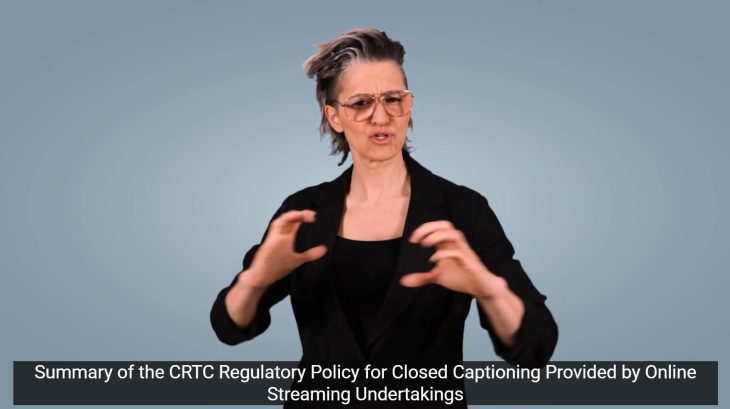
Screenshot of CRTC video, posted Monday, with closed captioning, via the regulator’s YouTube channel