Commissioner says CRTC could have suggested further solution for leftover customers
By Ahmad Hathout
Ztar Mobile Canada, a mobile virtual network operator (MVNO), has been denied an application to access Rogers’s system to port over its customers’ phone numbers to another network.
For 20 years, Ztar has operated brands including Good2Go Mobile, SpeakOut Wireless, and Ztar Mobile, reselling services through Rogers’s 3G network. But in late 2024, Rogers informed Ztar that it would not be renewing their resale agreement, claiming the reseller had millions of dollars in outstanding amounts it owed and the cable giant, in any case, was looking to decommission its 3G network, which was shut down on December 11, 2025. Rogers gave the company six months to June 2025 for up to 40,000 Ztar customers to find a new network for their phone numbers. Rogers agreed to another six-month extension for the same purpose.
Following the disconnection – and despite Rogers again temporarily providing system access in January – Ztar filed another request to the CRTC requesting an interim order to continue accessing Rogers’s system to port the remaining customers. Without access, Ztar, which has since found a new network operator, said it would be incapable of assisting its disconnected customers with porting, resulting in it having to rebuild an entirely new customer base or cease operations.
Rogers, however, claimed that the vast majority of those up-to 40,000 numbers saw no activity in the 90 days leading up to the December 11 disconnection, meaning it was unlikely that there would be porting requests from them. It also argued that providing such relief would excuse Ztar from its contractual obligations and force Rogers to carry additional costs with no avenue for recovery.
“The Commission is of the view that Ztar was given clear notice of disconnection and provided with multiple extensions,” the CRTC said in a decision Tuesday. “Ztar had approximately one year to port its customers from the time Rogers issued its first notice until disconnection on 11 December 2025.
“The Commission therefore considers that Rogers fulfilled its contractual obligations to Ztar and provided sufficient notice to Ztar of the impending disconnection,” it said, adding Ztar customers whose numbers had not been ported had already been disconnected for over six weeks before Ztar’s application was submitted. “During that period, their numbers would have been returned to Rogers’ numbering inventory and therefore may already have been reassigned to other customers.”
Having to hold what appeared to be inactive numbers in a sort of purgatory until porting requests are made would be “inconsistent with proper numbering resource management,” such as the inability to reassign them to other customers, the CRTC noted.
“The Commission considers that granting the requested relief could also have unintended consequences,” it added. “Requiring Rogers, which complied with its obligations, to provide a further extension to Ztar without assurance that overdue payments from Ztar will be recovered may influence how the industry approaches future disconnections. For example, service providers may have less incentive to prepare for disconnections and notify their customers of them if they believe that services can be extended indefinitely.”
The CRTC is ordering Ztar to inform its customers about alternative ways to obtain cellphone services, and notes that Rogers, which retains their previous phone numbers, would be in the best position to provide information about whether they can be retained or recovered.
Ztar did not respond to a request for comment, including about the consequences of the decision and about the millions of dollars in arrears on which Rogers claims the MVNO defaulted.
While Ontario Commissioner Bram Abramson agreed with the majority that Ztar did not establish a basis to require Rogers to restore system access, he said in a dispute between two companies, the commission cannot lose sight of the customers who actually want to keep their phone numbers.
“The disappearance of the ordinary porting pathway does not necessarily erase the underlying customer-number relationship,” Abramson said in a dissenting opinion. “Where that relationship can still be reliably established and the number has not been reassigned, meeting users’ economic and social requirements means taking reasonable steps to keep recovery possible, where this can be done reliably and proportionately.
“I would therefore go further,” he continued. “In this case I would require Ztar to preserve the validation capability for the existing cohort, and Rogers to provide only the cooperation reasonably necessary where an existing recovery path remains available.”
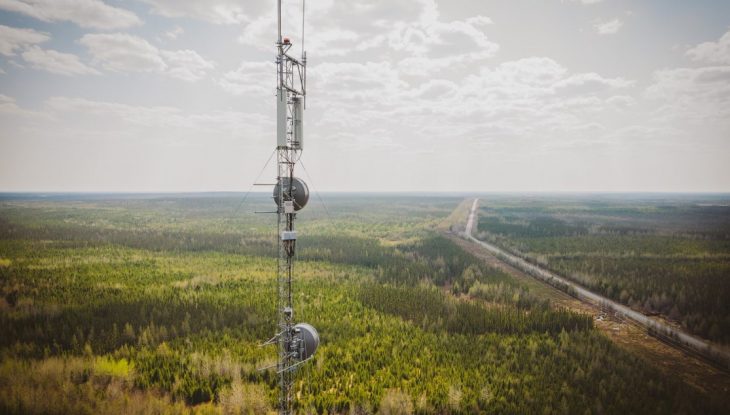
Photo of a Rogers tower