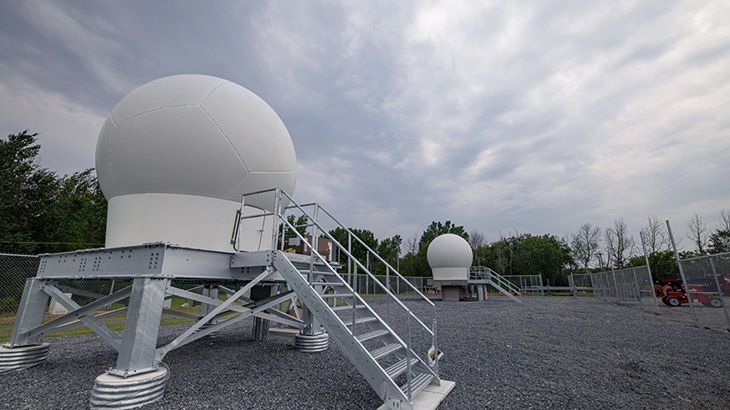
Calling it a “major milestone,” Bell announced Wednesday the completion of construction of its first sovereign direct-to-device satellite ground station, located in Quebec.
Testing has begun at the facility, which connects with AST SpaceMobile’s growing constellation of satellites, Bell said in a press release.
“Once operational, the site will form part of the Canadian infrastructure supporting direct-to-device satellite service, enabling the integration of AST SpaceMobile’s space-based cellular broadband network with Bell’s terrestrial network,” reads Bell’s press release.
Building on Bell and AST SpaceMobile’s successful demonstrations announced last October, Bell recently completed integration testing, including text messaging, broadband data connectivity, voice call and video call tests on standard smartphones through its satellite ground station, with plans to validate video streaming, IoT and public alerts in the coming weeks, Bell said.
“[T]hese tests mark the transition from trial activities to permanent infrastructure and are an important step toward bringing direct-to-device satellite service to market,” Bell’s release says.
Bell said construction of additional ground stations is underway in Ontario, Alberta, and Newfoundland and Labrador. Together, these facilities will support direct-to-device service across Canada via AST SpaceMobile’s satellites, ensuring Bell customers’ traffic is carried through domestic infrastructure and their data remains within Canada, Bell said.
“Delivering Canada’s best networks means finding new ways to connect customers beyond the reach of traditional wireless coverage,” Mark McDonald, executive vice president and chief technology officer at Bell, said in the company’s press release. “The satellite ground infrastructure we’re building is designed to support a full suite of direct-to-device capabilities, including messaging, data connectivity, voice calling, and video streaming, helping extend connectivity to remote and underserved areas. Together with Bell’s world-class wireless network, it will help keep customers connected wherever they live, work and travel.”
“Canada’s vast and diverse geography presents a unique need to extend cellular broadband beyond the reach of traditional terrestrial infrastructure,” Chris Ivory, chief commercial officer at AST SpaceMobile, said in a statement. “Bell’s continued investment in their mobile network, combined with AST SpaceMobile’s unique space-based cellular broadband technology, will extend coverage beyond the reach of traditional terrestrial networks and deliver a seamless connectivity experience on everyday smartphones everywhere, anytime.”
An anticipated launch date for Bell’s direct-to-device satellite service was not announced.
Telus has also partnered with AST SpaceMobile to bring satellite-to-cell service to its customers, including text messaging, voice calls and data, which the Vancouver-based telecom has said is planned for late 2026.
Rogers launched its commercial Rogers Satellite service in December, following a beta trial from July to October of 2025 using SpaceX’s Starlink satellites. In April, Rogers expanded its satellite-to-mobile service to the United States, via a partnership with T-Mobile’s T-Satellite.
Photo borrowed from Bell’s website