By Ahmad Hathout
The extent of spectrum sharing between Bell and Telus increased from 45 per cent to 90 per cent of each company’s total spectrum licence holdings following four new approvals this past fall to subordinate spectrum to each other, the department handling the airwaves confirmed to us.
Cartt obtained a backgrounder document on the state of spectrum sharing between the country’s largest telcos, which dates back to 2008. In it, Innovation, Science and Economic Development (ISED), which encourages such sharing, notes that since 2013, the department has approved about 20 separate joint requests from Bell and Telus to share spectrum with each other.
“The Bell/TELUS joint network is a longstanding partnership that enables the delivery of high-quality wireless services to a total of about 20 million Canadian subscribers while maintaining competition between these two major players in the market,” the backgrounder notes.
But just the last four approvals, spread across the country and published on October 9, 2025, doubled that spectrum sharing. “As a result of the four applications and decision, spectrum sharing between the two companies has increased from approximately 45% to 90%,” a department spokesperson confirmed to us.
“ISED recognizes that spectrum sharing can lead to significant cost savings and efficiency gains, enabling more rapid deployment of next-generation services to Canadians, including in rural areas,” the spokesperson said. “By increasing spectrum efficiency, spectrum sharing allows Canadians to maximize both the economic and social benefits of their wireless services.
“Licensees are still required to comply with their conditions of licence, including meeting prescribed deployment requirements within their licensed area,” the spokesperson added. “Additionally, both companies provide wireless services in the areas where they share spectrum.”
Bell and Telus did not respond to a request for comment.
The spectrum shared in the latest approvals includes the 3.5 GHz and 3.8 GHz mid-bands, which are crucial for 5G deployment. It was also these two bands that drew concerns about possible consolidation during the 3.8 GHz spectrum auction consultation.
Back in 2022, Rogers asked the department to reject the proposed 100 MHz spectrum acquisition cap, which Telus favoured, out of concern that Bell and Telus would just pool their spectrum winnings, giving the telcos a holdings advantage.
“There is no justification why the Bell-Telus joint network… should effectively be gifted with the opportunity to assemble and benefit from 200 MHz of mid-band spectrum while Rogers and other networks are limited to 100 MHz,” Rogers said in a submission to ISED at the time.
Rogers did not respond to a request for comment for this story.
Cogeco, Eastlink, Iristel, Quebecor and SaskTel argued for both an amount of spectrum to be set-aside exclusively for smaller carriers and an absolute cap on how much carriers can obtain across the board.
In the end, ISED settled on the spectrum cap of 100 MHz across both 3.5 and 3.8 GHz bands and no set-asides.
“It’s bad for the country, and the reason is simple: Canada is being told it has three national wireless competitors while two of them now run what is effectively one network,” Samer Bishay, head of far north service provider Iristel, told Cartt about the new development. “Ninety per cent shared holdings isn’t a partnership anymore. It’s a merger that never had to face a merger review.
“Competition isn’t determined by how many names appear on a licence,” Bishay continues. “It’s determined by how many independent networks a Canadian can actually be served by, and how many independent parties a smaller carrier can negotiate with for roaming and wholesale access. On both measures, this went from three to two.
“There’s also a front-door/back-door problem,” Bishay goes on. “ISED sets aside spectrum and enforces aggregation limits at auction precisely to seed competition. Then subordination lets two national incumbents undo that afterward, application by application, with no public process and no intervention rights for anyone affected. Each approval looks incremental. The cumulative result is 45 to 90%.”
As part of its policy to drive competition in the mobile wireless space, the CRTC mandates that the largest mobile network operators open their networks to competitors with facilities and spectrum. The mobile virtual network operator (MVNO) framework, established in 2021, will eventually sunset. By then, the expectation is that these competitors will make money from the regime to build out their own networks.
Cogeco, which operates a fledgling mobile wireless business, declined to comment. Eastlink, Quebecor and SaskTel did not respond to a request for comment.
In June, ISED published an interim update on its spectrum outlook, which includes modernizing the transfer policy to “make it easier and faster to transfer spectrum licences.”
The department has noted that repurposing spectrum bands – moving existing services to other bands to free up space – “has proven difficult,” hence why spectrum sharing is a preferred method of maximizing the finite resource.
“New applications relying on faster and ultra-reliable mobile broadband and the IoT, supported by 5G and evolving Wi-Fi technologies, are driving the demand for spectrum and thus, competing for access to spectrum that is already in use,” ISED said in its Spectrum Outlook document in 2023.
“Moving existing services is becoming more difficult, given increases in mobile data traffic, coupled with steadily growing demand for ubiquitous and faster broadband services, which is putting pressure on spectrum supply,” it added. “Related research has focused on finding other ways for various services and users to share spectrum more efficiently when it is technically feasible and practical to do so.”
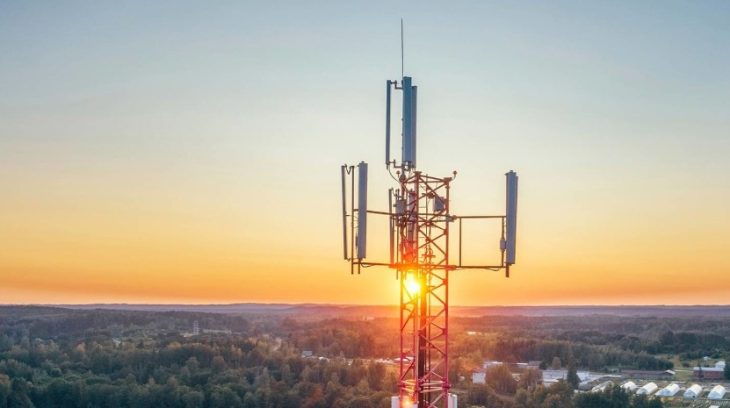
Photo of Bell tower