By Connie Thiessen
Structural shifts in the Canadian media landscape reached a critical milestone in the 2025 broadcast year, with online services capturing 40 per cent of total broadcasting revenues while traditional television and radio faced accelerating financial pressure.
According to the CRTC’s newly-released 2024–2025 Communications Market Report, overall commercial broadcasting revenues managed a modest 2.4-per-cent gain, driven almost entirely by a 13.9-per-cent surge in online service revenues. Conversely, traditional broadcast platforms saw revenues drop 4.1 per cent across the board.
The data underscores a fundamental transformation in how Canadians access news, sports, and entertainment, with streaming exclusive households rising to 33 per cent nationwide.
Traditional TV & radio under pressure
Conventional television bore the heaviest financial hit as ad dollars migrated to the digital space. Commercial conventional TV stations saw revenues drop 7.3 per cent to $1.17 billion in 2025, recording a historic low PBIT (Profit Before Interest and Taxes) margin of -40.4 per cent.
The commission said conventional television “is more directly exposed to this decline,” noting that the sector derived 92.3 per cent of its revenues from advertising in 2025. “Long-term data shows that conventional television was not profitable pre-pandemic, suggesting a longer-lasting trend rather than short-term financial pressure.”
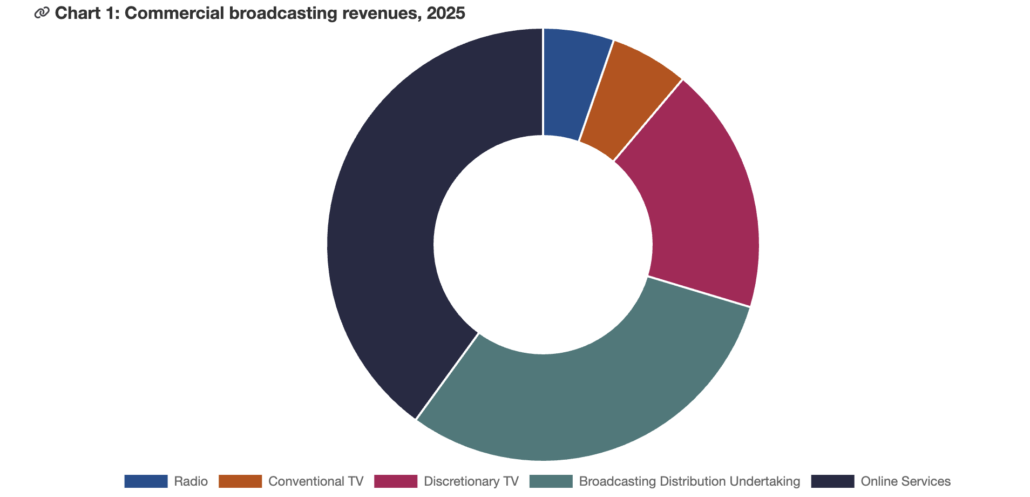
Traditional commercial radio revenues slid 2.6 per cent to $1.06 billion, hit by a softening local advertising market that generates over two-thirds of the sector’s income. Despite the downturn, radio remained relatively resilient compared to over-the-air television.
Meanwhile, traditional TV distribution undertakings (BDUs) – including cable, IPTV, and satellite – faced compounding subscriber losses, dropping 6.1 per cent annually in revenue over the last five years.
“The faster decline in BDU revenues relative to subscribers suggests that, rather than cutting the cord altogether, some Canadians may be adjusting their service packages by opting for lower-priced BDU tier services,” the report highlighted. Subscribers to packages priced at $100 or more plummeted 26.9 per cent year-over-year.
Francophone shift, Cancon spending steady
While francophone audiences have historically maintained higher engagement with traditional platforms, 2025 marked a noticeable shift. Weekly viewing hours for traditional TV in Quebec’s French market fell nine per cent, marking the first time since 2021 that the decline in French-language traditional viewing outpaced the rest of Canada (-6.2 per cent).
Total commercial television Canadian Programming Expenditures (CPE) held steady at $2.6 billion, buoyed by rising sports programming costs, which have grown at an annual average rate of 7.8 per cent since 2021. In contrast, news expenditures dropped by an average rate of 1.2 per cent per year over the same period.
“In 2025, entities with total broadcasting revenues exceeding $25 million paid approximately 45 per cent more in CPE than required,” the report noted, pointing to continuous private sector investment in domestic production despite falling profit margins.
According to the report, digital audio streaming now takes up 65 per cent of weekly audio listening hours, with 77 per cent of Canadians now subscribing to online video services, painting a picture of an ecosystem where online platforms are no longer just competing with legacy media, but defining the market.