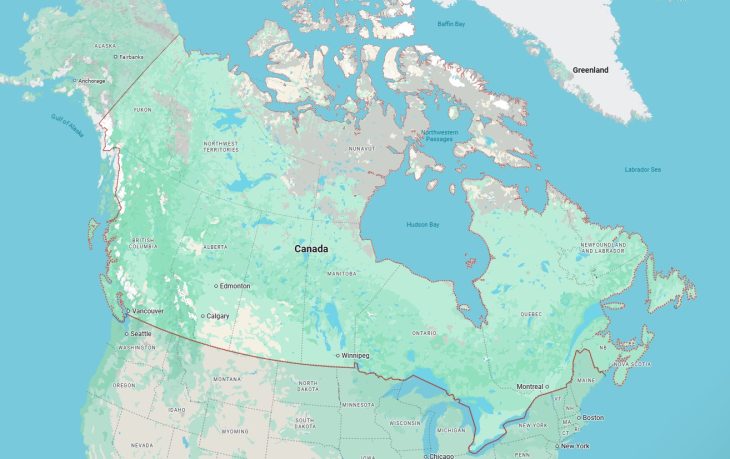
Innovation, Science and Economic Development (ISED) provided an update last week on the status of high-speed internet deployment across Canada, saying 96.4 per cent of Canadian households had access to internet meeting the federal government’s minimum speed objective of 50/10 Mbps at the end of 2024.
On behalf of ISED, Canada’s secretary of state for rural development, Buckley Belanger, provided the update in response to questions posed in the House of Commons in April by Conservative MP Leslyn Lewis, who represents the Ontario riding of Haldimand–Norfolk.
Belanger’s written response, presented in the House on June 10, cited the CRTC’s Communications Market Reports, 2026, as the source for data related to household connectivity broken down by province and territory. It noted the statistics are based on services delivered to homes via terrestrial technologies, and do not include coverage provided via satellite direct-to-home technology, which is available nationally.
According to the data, while 96.4 per cent of Canadian households overall had access to 50/10 Mbps internet at year-end 2024, only 83 per cent of rural households across Canada had comparable internet access by that time.
The most-connected province at the end of 2024 was Quebec, with 98.8 per cent of all households enjoying 50/10 Mbps internet speeds or better, including 94.6 per cent of rural households, according to ISED’s update.
The Atlantic provinces also had relatively high percentages of 50/10 Mbps internet coverage, including in rural areas. In Prince Edward Island, 97.1 per cent of all households had access to high-speed internet, including 94.8 per cent of rural homes. Nova Scotia’s figures were 96.6 per cent of all households and 92.4 per cent of rural households, while New Brunswick’s were 95.8 per cent and 91.6 per cent. The outlier in the Atlantic region was Newfoundland and Labrador, with 87.7 per cent of all households covered by high-speed internet and 73.6 per cent of rural homes.
In the western provinces, the gap between all households covered by 50/10 Mbps internet and rural households with access to those speeds was much greater. In British Columbia, high-speed internet access was available to 96.8 per cent of all households and 78.9 per cent of rural homes. In Alberta, the figures were 96.7 per cent and 79.5 per cent. In Saskatchewan, they were 87.3 per cent and 63.3 per cent. In Manitoba, they were 92.8 per cent and 75 per cent.
In Ontario, 96.3 per cent of all households in the province had access to 50/10 Mbps internet at the end of 2024, but only 77.5 per cent of rural homes had access to those connectivity speeds.
Of the territories, Yukon was the most-connected with 92.4 per cent of all households having high-speed internet access, including 82.9 per cent of rural households. In Northwest Territories, 90.7 per cent of all households had high-speed internet connectivity and 75.8 per cent of rural homes did so as well. For Nunavut, however, ISED’s update indicated no households in the territory had access to the federal government’s objective internet speeds of 50/10 Mbps, but that may be due to satellite coverage not being included in the statistics.
The federal government’s flagship initiative under its connectivity strategy is the $3.225-billion Universal Broadband Fund (UBF), designed to help provide high-speed internet access to 98 per cent of Canadian households by the end of 2026 and 100 per cent of households by 2030.
In ISED’s response to MP Leslyn Lewis’s questions in Parliament, Belanger wrote: “As of February 16, 2026, the Universal Broadband Fund has announced 417 projects targeting 704,000 rural, remote, and Indigenous households and has already connected more than 356,000 households, more than 26,000 of which are Indigenous.”
Belanger added that further UBF project announcements are expected in the coming months and as agreements continue to be finalized.
“The Universal Broadband Fund is complemented by initiatives such as the Canadian Radio-television and Telecommunications Commission’s Broadband Fund, which has allocated more than $771 million to connect more than 54,000 households in 320 communities, including 135 Indigenous communities, to high-speed Internet and improved mobile services,” Belanger wrote. “With federal, provincial/territorial, and private sector investments continuing to roll-out, the Government is on-track to meet its objective of universal coverage by the end of 2030.”
MP Lewis’s questions in the House of Commons in April also asked about the federal government’s ongoing development of regulatory and technical frameworks relating to lawful access, digital communications systems and telecommunications network design, including the proposals contained in Bill C-22, An Act respecting lawful access, which was tabled in March by the minister of public safety.
The bill proposes to expand lawful access powers in the Criminal Code and the Canadian Security Intelligence Service Act. It would require electronic service providers to retain certain metadata, which may include location and transmission data, for up to one year and also require providers to build technical capabilities facilitating lawful access to subscriber information and communications.
In a written response presented June 10 in the House of Commons, Jacques Ramsay, parliamentary secretary to the minister of public safety, wrote: “The development, analysis and consultations with regards to technical capabilities, requirements, and standards to enable lawful access would take place as part of the regulatory process if the proposed Bill C-22, An Act respecting lawful access, receives Royal Assent.”
Ramsay noted consultations with stakeholders “will be key since the electronic service providers are the ones that know their systems best and will be able to speak to feasibility, costs and potential impacts of the regulations. The Governor in Council would have the final say in what regulations are made under Bill C-22.”
Screengrab via Google Maps