By Ahmad Hathout
A $600,000 lifeline to a fund that bankrolls public interest participation in CRTC proceedings is again being financed through the authorities of the Canada Media Fund over a two-year period.
“This funding will ensure that Canadian public interest and consumer groups will continue to have the financial support needed to intervene in broadcasting proceedings before the Canadian Radio-television and Telecommunications Commission (CRTC),” says a January post on the Broadcasting Participation Fund (BPF) website, noting proceedings related to the Online News Act will not be funded through this program.
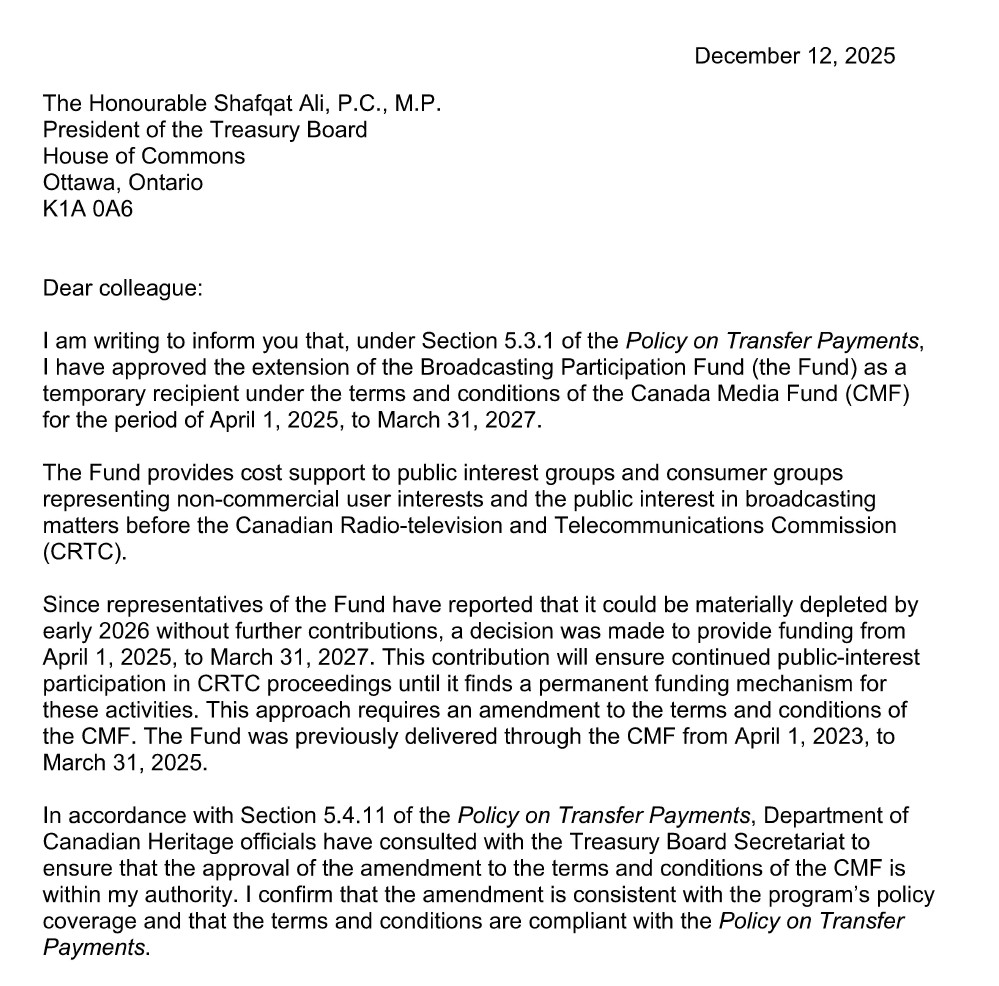
The details of the funding arrangement are outlined in documents obtained by Cartt. The $600,000 will flow during a two-year contribution period – between April 1, 2025 and March 31, 2027 – “using a temporary envelope of the Canada Media Fund” program, which is done by modifying the CMF’s terms and conditions, according to a December 7 memorandum. Culture Minister Marc Miller approved the funds on December 12, according to the letter below.
The BPF’s Costs Officer Michael Herot told Cartt that the funding period means that any participation by a public interest group from April 1, 2025 is eligible for these funds.
“This funding is critical to the BPF,” Herot told us. “It will enable continued processing of cost award claims in 2026 while awaiting the outcome of the CRTC’s Notice 2025-94 proceeding on funding for public participation expected later this year.”
The terms stipulate that the amount to be delivered in each fiscal year is not to exceed $500,000 and that the BPF must ensure that the funded projects “meet the purpose, priorities, and objectives of the overall CMF Program.”
Despite coming through a modification to its terms and conditions, the funding is not managed by the CMF, a Heritage spokesperson told Cartt. It is simply a contribution agreement between the department and the BPF using the authorities of the fund.
“The main objectives of this program are to: support the Canadian audiovisual sector by fostering, financing, promoting, and developing the production of, and access to, Canadian audiovisual content; help the Canadian content production ecosystem remain healthy, vibrant, and inclusive; and prioritize the success of Canadian content, by and for Canadians, reflecting the diversity of Canada’s voices,” the spokesperson said in response to a question about what keeping in-line with the “overall CMF program” means.
“It’s important for the public and consumers to have a voice in decisions about the rules for television, radio, and streaming companies, as it helps the CRTC make decisions in the public interest,” the spokesperson continued. “As such, supporting public interest interventions in CRTC proceedings via the Broadcasting Participation Fund helps achieve the Canada Media Fund Program’s objectives.”
When asked for comment, the CMF deferred to Canadian Heritage, which added that it chose this approach “because the CMF Program aligns with the broad policy objectives of this funding.”
This funding arrangement is not new. Heritage earmarked $650,000 over the previous two-year period — from April 1, 2023 to March 31, 2025 — after the fund “signaled the exhaustion of its reserves,” according to the December 7 memorandum. This money was used to deliver 67 cost awards for public interest participation in CRTC proceedings, the document added.
This time around, “without additional funding in the coming weeks, the Fund may be forced to go on hiatus pending that forthcoming decision on a new funding approach, which could prevent public interest intervenors to participate in the remaining CRTC’s processes to implement the Online Streaming Act,” the memorandum said.
The CRTC, which is modernizing the Broadcasting to bring online undertakings under regulation, has yet to make a decision on that new funding approach, which proposes creating a single fund for public interest participation. The regulator also wants to know if rates should be changed, whether there should be a different way to determine how much a party should receive, and who should be required to contribute to the fund and how that should be calculated.
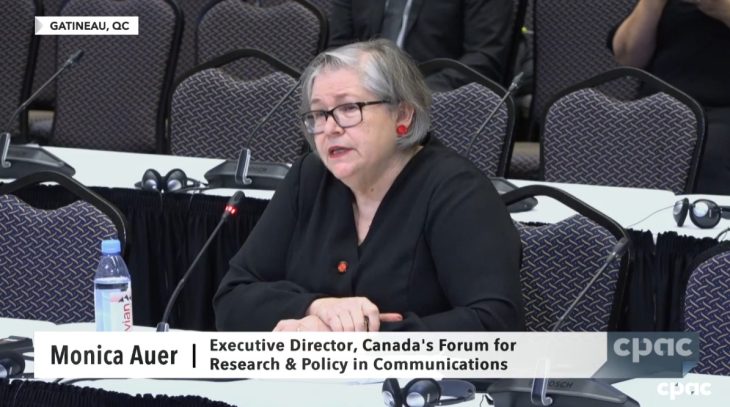
The BPF, which had its mandate expanded to include Online News Act proceedings, has complained to the CRTC that tangible benefits are not a path to sustainable funding of third-party participation — which includes the likes of the Public Interest Advocacy Centre (PIAC) and the Forum for Research and Policy in Communications (FRPC) — because broadcasting acquisitions don’t happen that often.
PIAC and the FRPC have filed applications to the CRTC within the past few years about sustaining public participation in these matters.