By Ahmad Hathout
The strings attached to the CRTC’s one-year limit for spoken word programming on the FM dial may end up discouraging radio stations from experimenting with the policy altogether, the Canadian Association of Broadcasters is arguing.
In January, the regulator finalized a proposal it made in the fall that will allow licensees of commercial FM radio stations to devote more than 50 per cent of weekly programming to that type of content for a one-year trial period. If before the end of the year, the stations stop broadcasting the requisite amount of spoken word content during the week, they cannot re-start without CRTC approval. If they wish to continue beyond the year, they must apply for a condition of service to do so.
The CAB said these rigid rules may actually deter stations from participating. “The strict one-year limit and the ‘no re-start without approval’ constraint in the case of the spoken word flex and the obligation to revert to original programming or revoke the AM licence in the case of the simulcast flex may end up limiting the willingness of radio stations to experiment with these changes,” the trade group said in a Part 1 application, made public Tuesday.
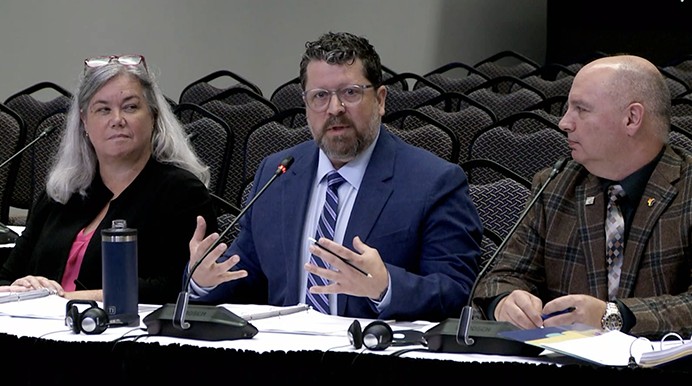
“This new flexibility was one of the few aspects of that decision that addressed concerns of commercial broadcasters, but in discussions with our members, some stated that they were unlikely to enact the operational changes because of the risk created by the one-year trial time limitation,” CAB President Kevin Desjardins told Cartt about the impetus for the application.
Desjardins noted that the concern comes from stations of all sizes, so smaller ones are not necessarily more impacted by the conditions compared to larger ones.
The organization, whose membership includes major private broadcasters, is asking the CRTC to replace the one-year trial with an ongoing standard authorization that will allow the stations, with notification to the regulator, to continue broadcasting spoken word programming without the need to get commission approval when it dips below the 50 per cent threshold and without the need to get a permanent condition of service after the year ends. The CAB said the commission can always review the stations if it believes they may not be compliant.
“Spoken word programming is often driven by time-sensitive local and national events (elections, emergencies, civic crises, major community events), and stations may need to move above or below the 50% threshold without being locked into a permanent obligation or facing an approval barrier to resume spoken word service,” the CAB says. “A notice-based approach provides transparency to the Commission while enabling stations to meet audience needs efficiently.”
The organization said its members did not have an opportunity to comment on this policy because the CRTC didn’t propose them previously.
“In practice, one year may not provide enough time for radio operators to reliably assess the effectiveness of a new news-talk station format,” the CAB said. “When a station changes format, it takes time: to create brand awareness and reset listener expectations; to perform audience research and implement any necessary changes; and to accurately measure ratings performance.”
In the same decision, the CRTC said it will allow the spoken word programming to be simultaneously cast on both AM and FM in the same market during the trial period, after which the stations would need to either stop simulcasting or apply to revoke the AM licence.
The CAB said the one-year trial period is not enough time to “fully migrate to migrate listeners to a new radio frequency. This kind of migration can take multiple years and requires concerted marketing and promotion to ensure that listeners effectively transition.”
Instead, the organization is asking the regulator to remove the simulcast restrictions entirely, or, alternatively, replace the one-year AM-to-FM simulcast trial with an ongoing exception permitting simulcasting beyond the 42 hours per broadcast week provided the stations give notice describing the arrangement.
If the CRTC finds that the stations are undermining the objectives of the Broadcasting Act, it can simply modify or remove the authorization, the CAB said.
“The CAB submits that the Commission’s framework already addresses the primary policy concern: the FM station may only simulcast content it is already permitted to broadcast, and therefore the measure is not a means to create an unauthorized specialty FM service,” the application says.
Screenshot of CAB President Kevin Desjardins at a CRTC hearing