By Ahmad Hathout
Rural broadband service provider Xplore is asking the department of Innovation, Science and Economic Development to pause authorizing SpaceX’s use of the E-band until international standards are established for co-existence with ground mobile wireless networks.
The American aerospace company filed a request with Innovation, Science and Economic Development (ISED) in December requesting that it be able to utilize the E-band (71-76 GHz downlink and 81-86 GHz uplink) for fixed satellite service (FSS) communications between its satellites and gateway earth station located at Saint-Laurent, Quebec and Janet, Alberta, which are currently serving users via the Ka-band. The E-band is used by terrestrial wireless network providers for backhaul.
Xplore, however, notes in a reply submission earlier this month that resolution 775 of the World Radiocommunication Conference (WRC) says that “Radio Regulations currently do not contain the necessary technical and regulatory provisions to protect fixed and mobile service use in the frequency bands 71-76 GHz and 81-86 GHz” and therefore protections are still being contemplated by the International Telecommunication Union (ITU) at the upcoming WRC in 2027.
“ISED should not unilaterally proceed to impose coexistence conditions that may not be consistent with international consensus,” Xplore said in its submission.
Xplore’s submission rebukes Rogers’s qualified support of SpaceX’s use of the band. The cable giant argued for an interim approval, so long as there’s no interference with current use, which for Rogers and other wireless network operators is to scale 5G transport and other point-to-point backhaul systems.
“[Future fixed service, FS] and FSS have typically coexisted effectively, owing to the technical characteristics of their deployments, so any additional use (by FSS) can be introduced in such a way to preserve terrestrial backhaul growth and investment certainty for the benefit of Canadian mobile users,” Rogers said in its initial submission. “Permitting SpaceX with FSS E-band authorization ahead of [World Radio Conference 2027] and domestic consultations will also benefit Canadian users and the broader economy by supporting additional investment in Canadian telecommunication facilities.”
If ISED approves SpaceX’s use before international standards, Xplore says the department that manages spectrum will be in the “unenviable position of balancing consistency with international policy and maintaining the experience of customers relying on the service enabled by the interim authorization,” the submission says.
“Given the rapidly changing and developing broadband landscape (including the potential introduction of Amazon Leo service), too much uncertainty exists to move out of lockstep with the international community,” it added.
Xplore says if ISED must approve SpaceX’s request, then it otherwise supports Rogers’s list of measures to ensure interim coexistence and share of the band on a no interference, no protection basis.
Xplore also agrees with Rogers that fixed service should retain primacy in the band because of its “crucial role” in current and future fixed wireless networks.
“The E-band is rapidly becoming the primary channel or achieving terrestrial backhaul capacity of 10 Gbps and higher and its use is essential to support 5G and future 6G network densification,” Xplore said.
It also agrees with the Canadian Association of Wireless Internet Service Providers (CanWISP), which said it wants ISED to “ensure transparent registration or coordination mechanisms, clear technical expectations for coexistence, and practical interference resolution processes accessible to operators of all sizes.”
Xplore said it has $2 billion over the last 17 years bringing high-speed internet to rural Canadians, including 5G fixed wireless and fibre networks to thousands of households, including in Quebec and Alberta.
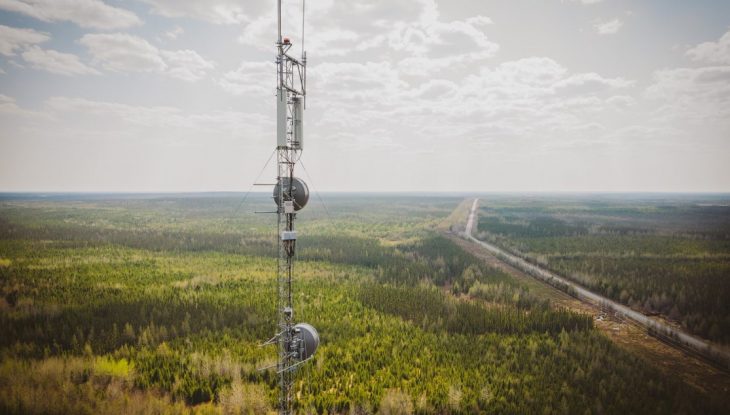
Photo via Rogers