
Bell, utilities say Community Fibre Company’s equipment not authorized on structures
By Ahmad Hathout
The head of Community Fibre Company (CFC), a small internet service provider in the Ottawa Valley, says his company “may not survive 2026” after permit delays and the removal of its unauthorized fibre equipment on poles.
“For a facilities based provider to be denied timely access to provide modern Fibre To The Premises services to more than 240 homes is simply devastating, and resulted in CFC losing out to more than $1.65 million dollars in revenue over the past 8 years (240 homes * 80% take-up with an average $90/month in revenue) combined with the uncountable damage caused by the compounded loss of growth,” the CFC said in a review-and-vary application provided to us by the company but not yet made public by the CRTC.
The CFC is asking the CRTC to revisit a decision in which it upheld a $7.5-million administrative monetary penalty (AMP) against Bell for not providing Videotron with timely access to its poles. The Lanark Highlands-based company argues that the regulator didn’t consider its own issues with Bell, which should have increased the penalties: specifically, that the telco giant allegedly delayed access to its poles for CFC’s connectivity projects including those covering Ramsay Concession 8 and Richmond while putting its own FTTP network in place.
“The anti-competitive actions taken by Bell Canada in these matters have resulted in significant harm to the Community Fibre Company leading to insolvency proceedings that are currently underway and which require additional relief which is being requested in a separate Part 1 application that is currently being prepared,” the R&V application states.
That separate Part 1 application – made public late last month and that targets Bell, Hydro One and Hydro Ottawa – similarly claims that CFC has, for years, been denied timely access to these poles. To address what it conveys as unjust delays, the company had placed unauthorized fibre facilities on the poles, which triggered Bell sending it several notices of disconnection over the years, the latest one being in November 2025.
Following the disconnection notice, CFC claims Bell destroyed 2.6 kilometres of CFC’s fibre network in the Valley, wiping out service to 59 homes. CFC says it took more than five days to restore service.
CFC does not dispute its use of unauthorized attachments on poles. In fact, it argues they were the “only reasonable option available to a small carrier with no other sources of revenue” in the face of what it alleges to be a “delay-and-deny strategy.” It further claims that its fibre is lightweight compared to older copper telephone cables that hung on these same poles and therefore constitute “materially insignificant alterations [MIA] to existing pole lines.”
The company claims it was never provided with “reasonable accommodation” to discuss the MIA design standard for engineering attachments to existing Bell strand.
“Unauthorized attachments are the only option when one doesn’t have permits from fully engineered and submitted permit requests,” the company’s founder and head Benjamin LaHaise told Cartt, noting that his company covers areas with no fibre-to-the-premises facilities or even DSL. “If CFC had only built where we had permits for at the time of construction, CFC would not exist as an entity. The customers in the fully permitted sections along John Aselford and Lucas Lane only came about because the residents there heard about CFC via other failed projects where fully engineered permits were delayed.”
The basis of CFC’s Part 1 complaint is an alleged undue preference. CFC claims it discovered that Bell had been allegedly installing fibre facilities on Hydro Ottawa poles without permits, showing that “Unauthorized Attachments are a part of the normal course of business practices for Bell Canada.” (Hydro Ottawa did not respond to a request for comment.)
“Without Bell Canada’s Unauthorized Attachments on Hydro Ottawa poles in December 2017, CFC would likely have obtained a market share of at least 120 of the ~160 homes, which can be quantified as an estimated $881,640.002 in lost revenue for CFC over the past 7.75 years,” CFC claims in its application.
As such, the CFC alleges that Bell is giving itself an undue preference by using unauthorized equipment on poles while denying the practice to competitors, including in areas – such as Ramsay Concession, Richmond and John Aselford Dr. – it had sought to build out with its own fibre network to continue operating.
“CFC’s allegations are without merit,” Bell said in a statement to Cartt. “They have not sought access to a single pole of Bell’s since 2019, have not paid for poles they are already on, and have been caught installing on our poles without our permission. It is unfortunate that CFC decided to file an application replete with mischaracterizations in an attempt to further delay disconnection and justify its longstanding non-compliance with pole access procedures.”
“Bell has given Community Fibre Company multiple opportunities since 2022 to settle outstanding payments, fix breaches and provide necessary permits to prevent disconnection due to unauthorized attachments. Our decision to proceed with disconnection on November 3, 2025 follows a prolonged history of non-compliance by CFC.”
The two companies entered a support structure agreement in the spring of 2014, the year after CFC was incorporated. Eight months later, Bell sent a notice to Lahaise stating that CFC’s first installation on Bell’s structures – a fibre line on poles on Watson’s Corners Road – was done without permission and not up to construction standards. It billed the company and requested the removal of the equipment or else it would do it at CFC’s expense.
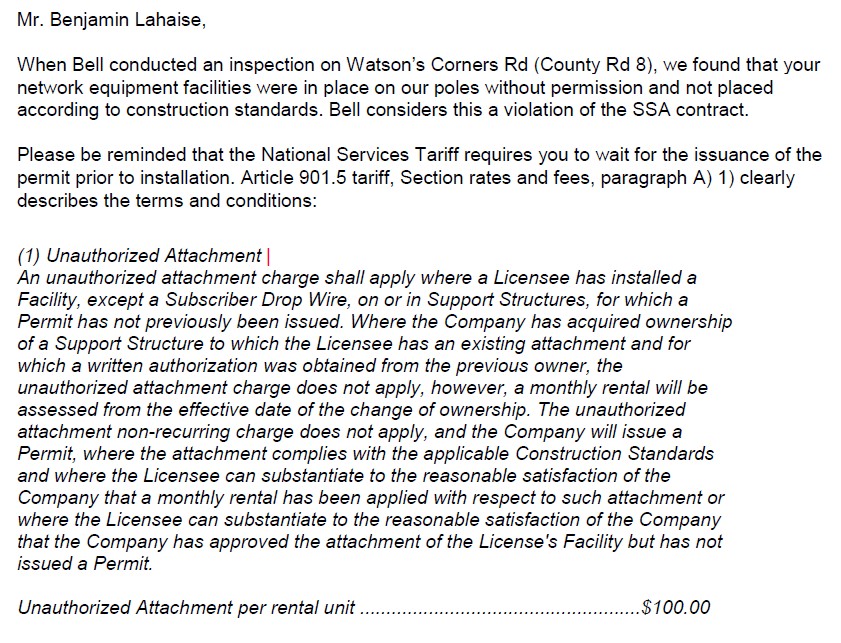
Hydro One also entered into an agreement with CFC for joint use of the utility’s distribution equipment in 2014, but eventually ran into the same issues.
“Hydro One has guidelines and a process for third parties to attach to our distribution equipment to ensure we are also able to safely operate and maintain the electricity system,” a spokesperson told Cartt. “They did not follow the guidelines and processes in place which has impacted their timelines for their requests to safely access and attach to our distribution equipment.”
In a story from September 2025, Inside Ottawa Valley reported that Hydro One had cut several of CFC’s fibre cables due to what it called safety issues.
“Community Fibre Company drilled and hung equipment into existing hydro poles that are not the appropriate size or strength to host additional equipment, nor is there the required space between equipment and, in some cases, the ground,” said senior media relations adviser Tiziana Baccega Rosa, according to the story.
In the summer of 2018 – following an expansion by CFC the year before – Bell sent a notice to CFC that it was going to terminate their support structure license agreement for disregarding “our permitting requirements” if certain conditions weren’t met, including providing a list of all locations with unauthorized CFC attachments. CFC provided the list and agreed to submit permits for all new attachments provided that Bell would process the permits in a timely fashion.
Bell claims the unauthorized attachments continued unabated and started to interfere with its own ability to safely deploy its own equipment. So, in May 2019, Bell provided notice to CFC that it was going to remove the unauthorized equipment at CFC’s expense the next month.
CFC went to the CRTC in June 2019, and, with commission assistance, the companies entered into a settlement that suspended the agreement’s termination in exchange for CFC getting permits to attach to approximately 800 Bell poles it previously was unauthorized to access and to pay outstanding amounts owed for those attachments.
In May 2024, Bell sent notice that it was going to terminate their agreement and then sued CFC in Ontario Superior Court for approximately $82,000 for breach of contract after CFC failed to pay the full amounts owed. CFC alleged in its $2.5-million wrongful termination counterclaim – which claimed Bell damaged its property – that the telco refused to accept its payments.
The alternative to pole access, CFC says, is wholesale internet service, but LaHaise says the monthly access fee of $121.79 at the time “was beyond CFC’s financial capacity.”
The issue with access to existing poles, the CFC says, demonstrates a problem and a solution that go beyond itself and its own issues: that pole owners are not “neutral arbitrators of access,” and that the CRTC needs to “revise” support structure and joint use agreements to “better support smaller carriers attempting to build their own FTTP networks.
The CFC is asking the CRTC, among other relief requests, to order telcos to define in their support structure tariffs the penalties for failure to grant permits within prescribed timelines.