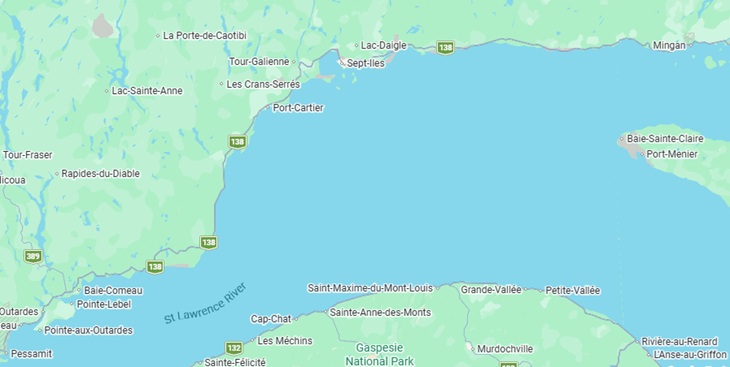
Telus announced last week the successful deployment and commissioning of its nearly 125-kilometre submarine fibre-optic cable connecting Sept-Îles on Quebec’s North Shore to Sainte-Anne-des-Monts on the Gaspé Peninsula.
Deployed and buried in the seabed of the St. Lawrence River in November and December 2025, this infrastructure is now in service and providing redundancy to the telecommunications network serving communities east of Baie-Comeau on the North Shore, Telus said in a press release.
This project, initially announced in 2020 and approved in July 2025, was made possible through a joint investment of more than $20 million from Telus and federal government.
“The completion of this state-of-the-art submarine infrastructure marks a historic moment for citizens along the North Shore — a region that has long faced connectivity challenges due to its remote location and vast, rugged landscape. Moreover, this important initiative demonstrates our TELUS team’s unwavering commitment to enhancing the resilience of our digital infrastructure in communities across the country,” said Darren Entwistle, Telus president and CEO, in a statement.
“As extreme weather and climate-related emergencies are becoming increasingly frequent, TELUS’ infrastructure will ensure that citizens, businesses and institutions in the region receive reliable access to essential services,” Entwistle added. “We are grateful to the Government of Canada for their partnership in co-funding this vital initiative, which underscores our shared dedication to building a connected, resilient and prosperous future for all Canadians.”
“The Government of Canada is committed to getting high-speed Internet for all Canadians by 2030. Led by TELUS, this project will improve network reliability for communities east of Baie-Comeau,” said Buckley Belanger, Canada’s secretary of state for rural development. “This is an important milestone for connectivity: it will make it easier to access healthcare and e-learning, while helping people stay connected with their loved ones.”
The commissioning of Telus’s submarine infrastructure creates a backup route ensuring continuity of telecom services in the event of failures or breaks on the main terrestrial network along Route 138 between Baie-Comeau and Sept-Îles, Telus said. The cable offers massive bandwidth capacity, ultra-low latency and multi-decade durability, while ensuring physical redundancy as part of Telus’s diverse route strategy, Telus added.
Telus said the project was anchored in responsible innovation, following strict standards for the protection of marine wildlife and the environment. During cable installation, the project team relied on a detection system combining thermal imaging, AI and human intelligence to prevent collisions and reduce sound impacts on marine mammals, which Telus said was a first in Canada.
Furthermore, environmental restoration work is planned for the spring and summer of 2026 to ensure the protection of the St. Lawrence River shorelines and to support the natural growth of resilient plants such as sea lyme-grass, Telus said.
The Vancouver-based telecom said this North Shore submarine cable project is part of Telus’s commitment to connecting regions, supported by $70 billion in planned investments through 2029 allocated to infrastructure development, business expansion and spectrum licence acquisition.