By Ahmad Hathout
Innovation, Science and Economic Development (ISED) has formally made way for a stretch of spectrum to be used for wireless backhaul capacity.
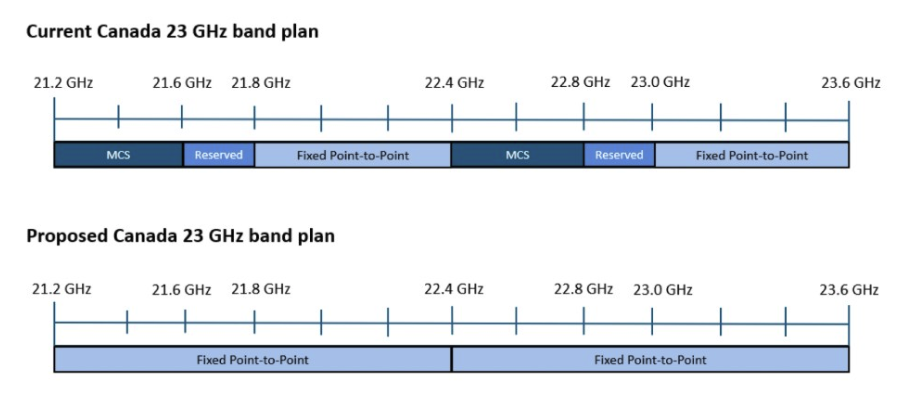
The department last month removed the multipoint communication system (MCS) designation for the 21.2-21.8 GHz and 22.4-23 GHz bands to create a contiguous stretch for fixed point-to-point systems, such as wireless backhaul. The repurposed spectrum will be licensed on a first-come, first-served basis.
“Enhanced backhaul capacity will be required so that the increased data traffic in a mobile network between the base station and a user can be effectively carried through the rest of the broader network,” ISED said in the decision. “Other types of networks, such as fixed wireless access and private networks, are also experiencing growth in capacity requirements which will also result in a need for proportional backhaul support.
“Based on these trends, a greater number of backhaul connections will be required, as well as higher speed demands for both new and existing backhaul links,” ISED continued. “While these backhaul connections are primarily achieved using fibre optics, a significant proportion will continue to rely on wireless point-to-point links. This will result in continued growth in demand on the limited supply of wireless backhaul spectrum.”
Rogers, Bell, Telus, and Quebecor supported the clearance of the band to allow them to meet increasing demands of broadband access networks and continued expansion and innovations in wireless technologies, including 6G.
ISED had previously held portions of those bands for either MCS or point-to-point radio systems. But after a review, it found MCS deployments “never materialized as anticipated” and no licences were granted in these bands, which were initially contemplated for applications including air and space communications.
“The demand for backhaul capacity is driven by the demands of other services, such as commercial mobile services,” ISED said in a consultation document in July. “In particular, different use cases and high data rates from 5G services are expected to have a significant impact on the future backhaul spectrum requirements.”
ISED says data traffic is expected to nearly triple by 2030, with a projected compound annual growth rate of 16 per cent, citing the latest Ericsson Mobility report from 2024.
“As such, enhanced backhaul capacity will be required so that the increased data traffic in a mobile network between the base station and a user can be effectively carried through the rest of the broader network,” ISED said this past summer. “Other types of networks, such as fixed wireless access and private networks, are also experiencing growth in capacity requirements which will also result in a need for proportional backhaul support.”
In 2020 and 2021, the department released spectrum in the 12.70-13.25 and 31.8-33.4 GHz bands for backhaul applications.
Last month’s decision is part of the department’s five-year spectrum outlook from 2023.
Photo via Bell